
Connector Second Sourcing: How to Qualify Alternatives
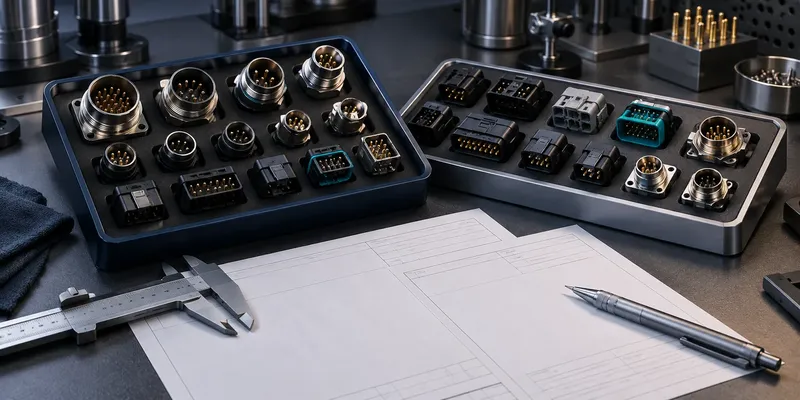
A second connector supplier can reduce exposure to a single production source, but only if its parts are ready for use when needed. A cross-reference list or a matching pitch does not establish that readiness. The practical goal is a documented alternative that engineering, quality and production can all release.
Start with the connector’s function in the product, then define what the alternative must preserve.
Decide what type of resilience you need
| Approach | Operating model | What to keep current |
|---|---|---|
| Active dual sourcing | Regular purchasing from two approved sources | Process capability, lot quality and capacity |
| Qualified reserve source | Mainly one supplier, with an approved backup | Availability, tooling readiness and qualification status |
| Single source with safety stock | Inventory covers a defined interruption | Consumption forecast and replenishment time |
| Planned assembly redesign | A controlled change removes a constrained interface | Design validation and service compatibility |
Two suppliers can still share an upstream factory, tool or material dependency. Ask about the supply path as well as the supplier name when assessing resilience.
Define compatibility at the part-number level
Footprint compatibility means the PCB mounting features align. It does not establish mating compatibility, identical electrical behavior or equivalent environmental performance.
Compare pitch, pad and hole geometry, board locks, locating posts, stack height and keep-out areas. Then compare the mating envelope, keying, latch operation, contact engagement and tolerance accumulation. Use controlled drawings rather than photographs alone.
For wire-to-board designs, include terminals, housings, wire range, seals and crimp tooling. If mixed-source mating is proposed, request supporting evidence and test the exact combinations. Changing both halves may be the more manageable option, but it also affects cables, spare parts and field service.
Build a risk-based validation plan
| Area | Evidence to collect |
|---|---|
| Electrical | Contact resistance, insulation and voltage suitability |
| Power | Temperature rise at the intended current and loading pattern |
| High-speed signals | Channel performance using the actual board or cable design |
| Mechanical | Insertion, withdrawal, retention and durability |
| Environment | Temperature, vibration, moisture and chemical exposure as applicable |
| Assembly | Solder or crimp process compatibility and inspection criteria |
Set acceptance criteria before testing. A pass/fail statement without conditions is difficult to compare between suppliers. Use the product’s operating risks to decide the sample plan and qualification sequence.
Include a production trial
Hand-built samples can hide problems with feeders, tooling, solder profiles or operator access. Run a representative production trial using the intended equipment and instructions. Track assembly yield, rework, dimensional variation and any tooling changes.
Compare total implementation cost, including qualification, tooling, scrap, inspection and inventory complexity. A lower unit price may still be useful, but it should not be the only approval criterion.
Release and maintain the alternative
Record the approved manufacturer part number and revision, permitted mating combinations, test evidence and any restrictions. Update the approved vendor list and purchasing system so “equivalent” does not become an uncontrolled substitution category.
Keep reserve sources active enough to confirm they can still supply the approved construction. Review product-change notices, capacity and sample availability at an interval appropriate to the application’s risk.
FAQ
Does the same pitch mean a drop-in replacement?
No. Pitch is one dimension. Housing geometry, tolerances, contact engagement and electrical performance still need review.
Must purchases be split equally?
No. The allocation should reflect demand, commercial terms and operational resilience. The backup source must remain practically usable.
Prepare a second-source enquiry
Send GSConn the original part number, both mating drawings, annual demand and acceptance criteria. Ask for a candidate comparison and sample plan. Treat the result as an engineering evaluation until the alternative has been approved.