
Connector Temperature Ratings: Derating and Material Limits
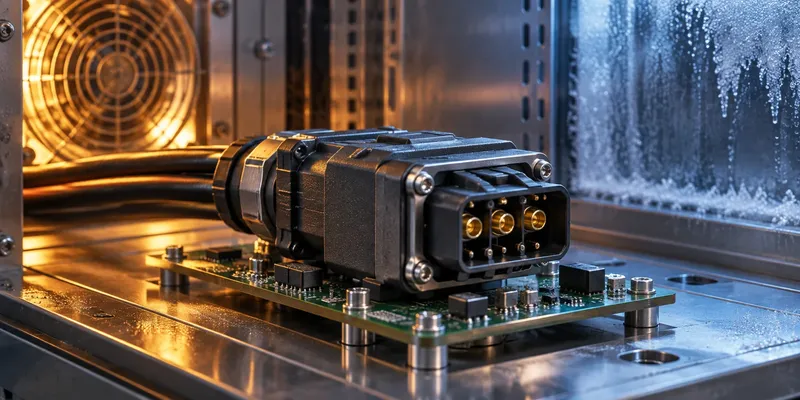
A connector’s temperature rating is not determined by the housing resin name alone. Contact springs, plating, insulation, seals, termination and the surrounding assembly can all limit performance. Current adds local heating, so a connector that survives a hot environment may not carry its headline current there.
Separate operating limits, material properties and solder-process compatibility before comparing products.
Understand the temperature terms
| Term | What it describes | What it does not establish |
|---|---|---|
| Operating temperature range | Conditions specified for the connector’s use | Full rated current at every ambient temperature |
| Glass-transition temperature, Tg | A polymer transition affecting material behavior | The finished connector’s continuous rating |
| Melting temperature, Tm | Melting behavior of a crystalline material | Allowable service or reflow conditions by itself |
| Relative thermal index, where applicable | Long-term thermal-aging performance for a material property | Qualification of the complete connector |
| Solder-process limit | Permitted assembly exposure under specified conditions | Continuous operating temperature |
Do not label melting-point values as Tg. Likewise, flammability classification is not a current rating or a general maximum-use temperature. Material grade, thickness and the relevant test conditions matter.
Use a part-specific current derating curve
A current derating curve relates allowable current to the specified thermal conditions. Conductor size, mounting, adjacent loaded contacts and the test method affect the result. Request the test configuration with the curve so the result can be compared with the intended installation.
There is no universal rule that a connector loses a fixed percentage of current capacity between two temperatures. Do not apply a generic table from another connector family. Check whether the curve already includes the intended loading arrangement before adding further factors.
A useful thermal check is:
Local ambient temperature + current-induced temperature rise must remain within the applicable connector temperature limit, with the required design margin.
As an illustration, an 85°C local ambient and a measured 20°C rise produce approximately 105°C at the measured point. This arithmetic does not establish allowable current; that requires the actual temperature limit, representative measurements and the approved evaluation method.
Compare materials by grade and function
PBT and polyamide grades are used in many connector housings. LCP and high-temperature polyamides are common candidates where dimensional stability and solder processing are important. PPS, PEEK and ceramic can be considered for more demanding requirements, but their names do not guarantee a specific connector rating.
Ask for the actual resin grade and finished-product qualification. Check moisture sensitivity, chemical exposure, mechanical strength and long-term contact retention as well as heat resistance. A housing that retains its shape is not enough if contact spring force or seal performance deteriorates.
Confirm the complete solder profile
A reflow peak is only one part of the assembly process. Obtain the permitted profile, exposure time, number of cycles and any handling or drying instructions for the connector. Follow the component and assembly-process requirements together.
Do not assume that every part made from a particular resin is reflow-compatible, or that a material family can only be used with through-hole soldering. The manufacturer’s approved process for the exact part is the deciding evidence.
Test the installed configuration
Use the production wire size or PCB copper, actual contact loading, enclosure airflow and neighboring heat sources. Measure the hottest relevant points until the defined steady condition is reached. Review startup peaks or duty cycles separately where they affect the design.
If environmental cycling, vibration or repeated mating can increase contact resistance, include the required aging sequence before the final thermal assessment. Record the load, ambient measurement location and acceptance limits so the results can be reproduced.
FAQ
Can a 125°C connector carry full current at 125°C ambient?
Not necessarily. Current creates additional heating, and the stated limit may include that rise. Use the datasheet’s definitions and derating information.
Is a 260°C solder exposure a 260°C operating rating?
No. A short assembly exposure and continuous service are different requirements.
Prepare a thermal selection enquiry
Send GSConn the local ambient range, load profile, number of energized contacts, wire or PCB details and solder process. Ask for the applicable derating and process data for the candidate part before approving it.