
USB Connector for EV Charging — Design Requirements & Selection
Quick Summary
| Parameter | Requirement |
|---|---|
| Temperature range | -40°C to +85°C (charge point exterior), -40°C to +105°C (internal electronics) |
| IP rating | IP65 minimum (outdoor charge point), IP67 recommended (coastal, high-dust) |
| USB function | Firmware update, payment terminal, advertising display, remote diagnostics |
| USB speed | USB 2.0 sufficient for firmware/payment; USB 3.0 for display/telemetry |
| Environmental | UV-resistant housing, salt spray (coastal), thermal shock (day/night cycle) |
1. Why EV Charging Stations Need USB
AC charge points (Level 2) and DC fast chargers (Level 3) are networked devices. They need USB for functions beyond the power delivery chain:
| Function | USB Port | Data Rate | Connector |
|---|---|---|---|
| Firmware update (field service) | Front panel | USB 2.0 | Type-A |
| Payment terminal (credit card reader) | Internal | USB 2.0 | Type-A or Type-C |
| Advertising display (LCD signage) | Internal | USB 3.0 | Type-C |
| Remote diagnostics modem (4G/5G) | Internal | USB 2.0 | Type-A |
| Maintenance log export | Front panel | USB 2.0 | Type-A |
| OCPP (Open Charge Point Protocol) gateway | Internal | USB 2.0 | Type-A |
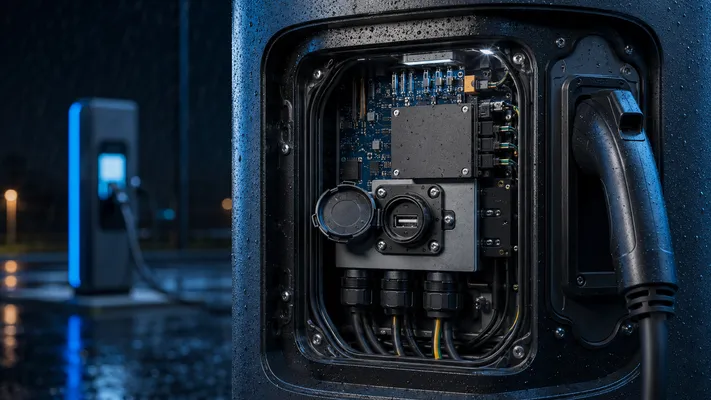
Two USB ports are common: one externally accessible for field service (firmware update, log export), one internal for internal peripherals (display, modem). Stacked USB connector provides both in one panel cutout.
Scope Clarification
In EV charging station, USB should be positioned accurately: USB is usually a service, diagnostics, firmware, logging, payment accessory, or HMI peripheral interface. It is not the vehicle charging interface; AC/DC charging communication and power transfer are handled by EVSE standards and charging connectors. This distinction matters for engineering credibility and prevents the article from overstating USB’s role in safety-critical or real-time control paths.
2. Environmental Challenges (Outdoor Charge Points)
Temperature
| Condition | Value |
|---|---|
| Outdoor ambient (worst case) | -30°C (Scandinavia winter) to +50°C (Arizona summer) |
| Solar heating of enclosure | +15–25°C above ambient |
| Internal electronics temperature | Up to +75°C ambient in enclosure |
| Thermal shock | 30°C delta in 30 minutes (sunset + cold front) |
Requirement: USB connector rated -40°C to +85°C minimum (industrial grade). Enclosure interior can reach +90°C with solar loading — extended temp (-40°C to +105°C) recommended for internal connectors. LCP or PPS housing material required; standard PBT insufficient.
Moisture & Dust
| Condition | Value |
|---|---|
| Outdoor rain | IPX4 minimum (splash from any direction) |
| Driving rain + wind | IPX5 (water jet) |
| Coastal salt fog | IP66 + salt spray test (IEC 60068-2-52) |
| Desert dust | IP6X (dust-tight) |
Requirement: IP65 minimum for externally accessible USB port. IP67 with mated connector cover if port faces upward or is exposed to driving rain.
Mechanical & Vibration
| Condition | Source |
|---|---|
| Vibration (near highway) | 5–15g RMS, 10–500 Hz |
| Impact (vandalism, accidental) | 30g shock, 11ms |
| Cable pull (user tugging on charge cable) | Not directly on USB, but enclosure vibration transfers |
Requirement: Through-hole mounting for internal USB. Panel-mount with screw-lock for externally accessible USB. Vandal-resistant cover (locking flap) recommended for public charge points.
UV Exposure
Outdoor charge points face 10+ years of solar UV. Standard PBT yellows and becomes brittle. LCP and PPS are UV-resistant without additives.
3. Charge Point Architecture: Where USB Fits
AC Level 2 Charge Point (7–22 kW)
[Grid] → [Main controller (Linux/RTOS)]
              ├── USB 1 (internal): 4G modem → OCPP cloud
              ├── USB 2 (internal): LCD display driver
              └── USB 3 (front panel, service): firmware update, log export
GSConn recommendation: Stacked USB 2.0 pair (internal modem + display) + single USB 2.0 Type-A (front panel, IP65 rated, locking cover).
DC Fast Charger (50–350 kW)
[Grid] → [Power modules] → [Main controller]
                              ├── USB 1 (internal): payment terminal
                              ├── USB 2 (internal): advertising display (USB 3.0)
                              ├── USB 3 (internal): 4G/5G modem
                              └── USB 4 (front panel): service port, IP67 rated
GSConn recommendation: Stacked USB 3.0 (display + modem) + stacked USB 2.0 (payment + spare) + single IP67 front-panel USB.
4. Front Panel USB: The Hardest Part
The externally accessible USB port is the most demanding:
| Requirement | Specification |
|---|---|
| IP rating | IP65 minimum, IP67 recommended |
| Cover | Spring-loaded or screw-on, tethered (not lost) |
| Locking | Recommended (prevents accidental disconnect during service) |
| Material | LCP housing, stainless steel shell option |
| UV resistance | Required (10+ year outdoor life) |
| Operating temp | -40°C to +85°C |
| Mating cycles | 1,500 minimum (firmware updates, quarterly over 10 years) |
GSConn solution: IP67 panel-mount USB Type-A, screw-lock, stainless steel shell, spring-loaded tethered cover, LCP housing. Available in single or stacked (dual-port) configuration.
5. Compliance Standards
| Standard | Applies To | Requirement |
|---|---|---|
| IEC 61851-1 | EV conductive charging system | General safety |
| IEC 61851-21-2 | EMC for EV charging | Radiated/conducted emissions |
| ISO 16750-4 | Environmental (road vehicles) | Temperature, humidity, salt spray |
| IEC 60068-2-6 | Vibration | 10–500 Hz, 5g |
| IEC 60068-2-14 | Thermal shock | -40°C ↔ +85°C, 100 cycles |
| IEC 60529 | IP rating | IP65 (dust + water jet) minimum |
| UL 94 | Flammability | V-0 for all plastic parts |
Note: USB connectors themselves are not certified to IEC 61851 — that’s the complete charge point assembly. But the connector’s temperature, IP, and flammability ratings typically should support compliance.
6. Comparison: EV Charge Point vs Industrial Enclosure
| Factor | EV Charge Point | Typical Industrial PC |
|---|---|---|
| Temperature range | -40–85°C (outdoor) | 0–60°C (indoor) |
| IP rating | IP65+ mandatory | Optional |
| UV exposure | Yes (10+ years) | No |
| Vandalism risk | High (public access) | Low (controlled access) |
| Service interval | <2 years (warranty) | 5–10 years |
| Cost sensitivity | Medium | Low (reliability > cost) |
| USB connector | Panel-mount, locking, IP67 | Through-hole, standard |
Bottom line: EV charge point USB requirements are closer to outdoor telecom than to industrial PC. Design for 10+ year outdoor life.
7. GSConn EV Charging Connector Recommendations
| Charge Point Type | Internal USB | Front Panel USB | Notes |
|---|---|---|---|
| AC Level 2 (home) | Standard USB 2.0, SMT | Not needed (no public access) | Wi-Fi for OCPP, no service port |
| AC Level 2 (public) | Stacked USB 2.0, through-hole | IP65 panel-mount Type-A | Service port + internal modem |
| AC Level 2 (commercial) | Stacked USB 3.0 + USB 2.0 | IP67 panel-mount, locking | Payment terminal + display + service |
| DC Fast (50 kW) | Stacked USB 3.0 + stacked USB 2.0 | IP67 panel-mount, locking | Dual display + payment + modem + service |
| DC Ultra-fast (150–350 kW) | As above + spare ports | IP67 panel-mount, locking | Redundancy for uptime SLA |
GSConn manufactures industrial-grade USB connectors rated to -40°C to +85°C (extended -40°C to +105°C on request) with IP67 panel-mount and locking options suitable for EV charging applications. Stainless steel shell and UV-resistant LCP housing available for long outdoor service life. Custom assembly with tethered dust cover available.
Related reading:
– Industrial USB Connector Complete Guide
– Panel Mount USB Connector Selection Guide
– Locking USB Connector Guide
Technical References for Editorial Review
This article was reviewed for engineering accuracy against commonly used connector and USB ecosystem references, including USB-IF Type-C / USB4 / USB Power Delivery documentation, IEC 60512 connector test methods, EIA-364 test methods, and representative connector manufacturer datasheets. Always verify final dimensions, plating thickness, reflow limits, and durability ratings against the exact connector datasheet before releasing a design.