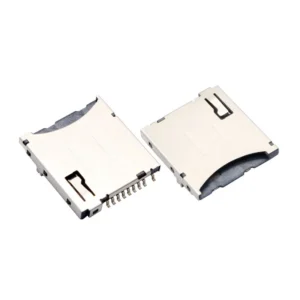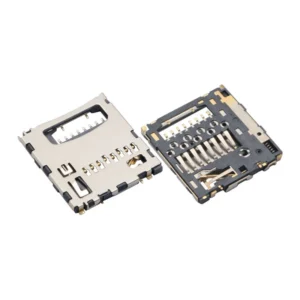
Push-Push vs Hinged microSD Socket for Outdoor Equipment

Outdoor equipment stresses the mechanism twice
An outdoor device does not simply experience more of the same conditions as an indoor one. It experiences a different combination: daily thermal cycling that works the mechanism loose and tight, moisture that condenses on the coldest surface, and vibration from wind, mounting structures, or the equipment itself.
For a microSD socket, the choice between push-push and a hinged cover is usually made on the basis of cost and convenience. In an outdoor enclosure that choice should be made on the basis of which mechanism survives the combination.
What thermal cycling does to a latch
A push-push latch holds the card with a small stamped spring pressing into a notch. The spring is sized for a nominal gap at room temperature.
When the assembly heats, the housing and the card expand at different rates. The card is a moulded laminate; the housing is a glass-filled thermoplastic. Their coefficients of thermal expansion differ enough that the fit between them changes measurably across a −40 °C to +85 °C range.
| Condition | Effect on the latch | Accumulated over years |
|---|---|---|
| Cold | Materials contract; the notch engagement loosens | Wear on the latch tip |
| Hot | Housing expands more than the card; the latch is pushed against its stop | Spring relaxation |
| Transition | Micro-motion between latch and notch | Fretting wear on both surfaces |
One cycle per day for five years is 1,825 cycles of micro-motion on a part that was specified for 5,000 full insertions. The insertion count looks comfortable. The micro-motion count is a different loading regime, and it is not what the cycle rating describes.
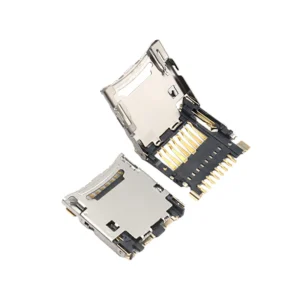
A hinged cover also moves with thermal cycling, but its retention comes from a clamp that is pre-loaded over a large area. A small change in the gap changes the clamp force slightly rather than moving a latch out of engagement.
Condensation: the failure mode that has nothing to do with the mechanism
Outdoor enclosures breathe. As the internal air cools overnight, moisture condenses on the coldest surfaces — often the metal shell of a connector or socket, because metal tracks ambient faster than plastic.
| Socket design | Condensation behaviour | Risk |
|---|---|---|
| Open body, contacts facing down | Water drains away from the contact area | Low |
| Open body, contacts facing up | Water pools on the contact block | High — electrochemical migration |
| Closed body, no drain | Water accumulates inside | High over years |
| Sealed socket in a sealed enclosure | No internal condensation if the enclosure is truly sealed | Low, but the seal becomes the critical part |
Orientation is a free design decision that is frequently made by accident during layout. A socket whose contacts face upward collects condensation at the point where it does the most damage. If the layout allows, mount it so the contact block is above the card plane rather than below.
The “closed body with no drain” case is a trap because it looks more protective. Water that enters — through the card slot during handling, or as vapour that condenses inside — has no way out, and stays in contact with the terminals.
Vibration compared
| Mechanism | Behaviour under sustained vibration | Failure signature |
|---|---|---|
| Push-push | Latch resists motion; wear at the notch | Card ejects, or latch will not release |
| Hinged cover | Card clamped; motion is taken by the hinge | Hinge pin wear, lid loses pre-load |
| Push-pull | Friction retention falls; card creeps | Intermittent errors before total loss |
| Tray | Card retained by tray; tray retained by frame | Tray gasket wear |
The hinged cover converts a retention problem into a hinge wear problem, which is a better trade because hinge wear is gradual and visible during service, while latch failure is sudden and produces an eject.
The enclosure interface matters as much as the socket
An outdoor device usually has a door or a gland through which the card is accessed. That opening is a larger environmental risk than the socket itself.
| Access method | Socket choice | Sealing responsibility |
|---|---|---|
| Screw-down door with gasket | Hinged cover, open body | Door gasket |
| Sealed gland, cable only | No user access; factory-fitted card | Gland |
| Removable tray through a slot | Tray socket | Tray gasket |
| No opening, card potted in | Drop-in or push-pull, no access | Enclosure only |
The second and fourth rows are worth considering seriously. If the card never needs to be removed in the field, eliminating the access opening removes an entire failure class. A device that logs to internal flash plus a factory-fitted card is more reliable outdoors than one with an accessible slot, even if the slot has a good gasket.
Qualification sequence for outdoor use
The order of tests matters, because the combined effect is worse than any single test suggests.
| Step | Test | What it exposes |
|---|---|---|
| 1 | Insertion cycle to rated life | Baseline mechanism wear |
| 2 | Thermal cycling, card installed | Latch relaxation, differential expansion |
| 3 | Damp heat, biased | Plating corrosion, electrochemical migration |
| 4 | Vibration sweep and dwell, card installed | Retention under motion |
| 5 | Repeat 2–4 | Combined degradation |
| 6 | Functional and contact resistance check | End-state performance |
Running thermal cycling before vibration is deliberate: the thermal cycles loosen the mechanism, and the vibration then acts on a loosened part. Testing in the opposite order finds less.
Decision table
| Condition | Push-push | Hinged cover | Recommendation |
|---|---|---|---|
| Card accessed yearly in a cabinet | Marginal | Good | Hinged cover |
| Card never accessed after commissioning | Acceptable | Good | Either; hinged if vibration present |
| Continuous vibration | Poor | Good | Hinged cover |
| Daily thermal cycling, wide range | Poor | Good | Hinged cover |
| Height-constrained, indoor only | Good | Too tall | Push-push |
| Sealed enclosure, no access | Not applicable | Not applicable | Drop-in, sealed in |
FAQ
Why does a push-push socket fail outdoors when it is rated for 5,000 cycles? The rating describes full insertion cycles. Thermal cycling produces micro-motion on the latch that is a different loading regime, and it relaxes the spring without counting toward the rating.
Is a hinged cover waterproof? No. It provides retention, not sealing. Sealing comes from the enclosure or from a tray gasket.
Which orientation reduces condensation damage? Contact block above the card plane where possible, so water drains away from the contacts rather than pooling on them.
Should I eliminate the card slot entirely? If the card is never removed in service, yes. Removing the access opening removes an entire failure class.
What test order should I use? Cycles, then thermal, then damp heat, then vibration, then repeat. Thermal before vibration is the sequence that exposes combined degradation.
Does a metal hinged cover help with heat as well? Yes. It adds thermal contact area, which matters if the card writes continuously.
Micro SD / TF Card Connectors for this design
View all 44 parts →