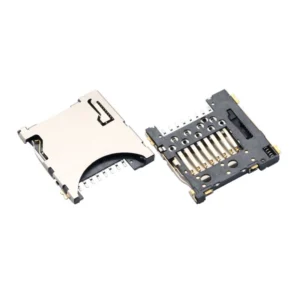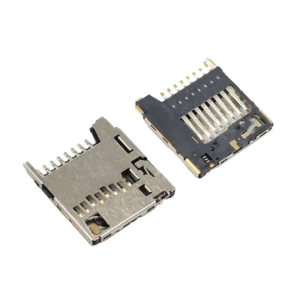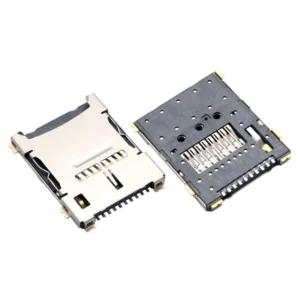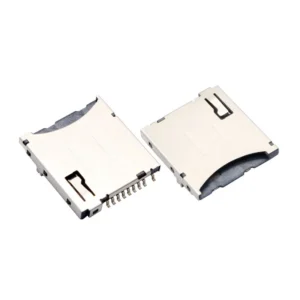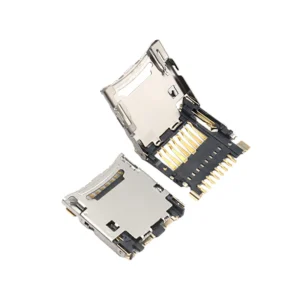
Ultra-Low-Profile microSD Sockets at 1.28mm: Contact Force Trade-offs

What 0.2 mm of height costs in contact reliability
Low-profile microSD sockets are sold on height: 1.28 mm instead of 1.5 mm, or 1.85 mm. In a device where the battery occupies most of the internal volume, that 0.2–0.6 mm is the difference between fitting the card slot and losing battery capacity.
The cost is not in the height. It is in the terminal beam, which has less room to travel, and therefore less ability to generate and maintain contact force across the tolerance range of real cards.
This article explains the mechanical trade-off and identifies when the lowest profile is the wrong choice even though it fits.
The height budget of a microSD socket
A microSD card is nominally 1.0 mm thick, with a tolerance in the region of ±0.05 mm. The socket has to accept that card, provide contact force, and keep the whole assembly within its stated profile.
| Socket profile | Card thickness | Remaining height for shell and beam | Practical beam travel |
|---|---|---|---|
| 1.28 mm | 1.0 mm | ~0.28 mm | Very limited |
| 1.5 mm | 1.0 mm | ~0.50 mm | Moderate |
| 1.85 mm | 1.0 mm | ~0.85 mm | Comfortable |
The remaining height has to cover the shell wall, the contact beam in its deflected position, and clearance. At 1.28 mm there is very little left, and the beam is necessarily short and stiff.
Force from a short beam
Contact force comes from deflecting a cantilever spring. For a given material and width, a shorter beam is stiffer:
Stiffness rises with the inverse cube of beam length.
Halving the beam length makes it roughly eight times stiffer for the same deflection. That sounds like an advantage — more force per unit of travel — and in a low-profile socket it is how the designer recovers contact force from a smaller envelope.
The disadvantage is what happens when the card is thinner than nominal.
| Card thickness | Deflection in a 1.28 mm socket | Force change | Consequence |
|---|---|---|---|
| 1.00 mm nominal | Design value | Design value | Correct |
| 0.95 mm (low tolerance) | Reduced | Falls steeply because stiffness is amplified | Margin lost faster than in a taller socket |
| 1.05 mm (high tolerance) | Increased | Rises steeply | Insertion force up; beam stress up |
| 0.90 mm (worn or low-grade card) | Much reduced | May fall below the minimum for reliable contact | Intermittent detection |
A stiff beam converts card thickness variation into large force variation. A compliant beam absorbs the same variation with a smaller force change. The low-profile socket is necessarily the stiff one.
The insertion force consequence
Contact force and insertion force are not the same number, but they are linked. A stiff beam with six or eight contacts produces a higher total insertion force for the same deflection.
| Socket | Relative insertion force | User experience | Mechanical cost |
|---|---|---|---|
| 1.85 mm | Baseline | Firm but smooth | Board must resist the push |
| 1.5 mm | Slightly higher | Firm | Same |
| 1.28 mm | Noticeably higher | “Stiff” or “tight” | Solder joints and housing take more load |
Users report a stiff card slot as a quality problem even when it is functioning correctly. That perception matters in consumer products, less so in industrial ones where the card is inserted by a technician.
The mechanical cost is real: every insertion transfers force through the socket body into the solder joints. In a right-angle SMT part with small pads, repeated stiff insertions fatigue the joints. This is one of the reasons a low-profile socket on a thin board needs mechanical anchoring.
Where the low profile is the right choice
| Condition | 1.28 mm appropriate? | Reason |
|---|---|---|
| Card fitted at the factory, never removed | Yes | One insertion; force variation is a non-issue |
| Height is the binding constraint under a battery | Yes | Physical necessity; accept the trade-off |
| User-accessible slot in a handset | Conditional | Acceptable if card quality is controlled |
| Outdoor device with a service interval | No | Contamination plus variable card thickness |
| Machine-mounted with vibration | No | Stiff beam plus micro-motion is a fretting risk |
| Cards sourced from multiple vendors | No | Thickness spread across vendors exceeds the margin |
The multi-vendor row is underrated. In a product where the end user supplies the card — a camera, a recorder, a field instrument — the thickness spread is not under your control. Users insert cards of unknown provenance and wear. A compliant socket tolerates that; a stiff one does not.
What to test before committing
| Test | Method | Pass condition |
|---|---|---|
| Contact resistance across card thickness | Measure at nominal, minimum and maximum card thickness | Under the limit at the minimum thickness |
| Insertion force | Force gauge, at maximum card thickness | Below the user-comfort threshold for the product class |
| Retention | Pull test, after rated cycles | Above the minimum with the thinnest card |
| Beam set | Cycle at maximum thickness, then re-measure at nominal | Resistance returns to the nominal-thickness value |
| Joint fatigue | Repeated insertion with the board mounted as in the product | No solder joint cracking after the rated cycles |
The fourth test is the one that catches the permanent-set failure described in the previous section. A beam that has been over-deflected does not spring back, and the only way to see it is to measure resistance at nominal thickness after cycling at the thick end.
Compensating design measures
If the low profile is unavoidable, three measures reduce the risk.
| Measure | Effect | Cost |
|---|---|---|
| Specify card thickness window to the card supplier | Narrows the input variation | Purchasing constraint; may not be possible for user-supplied cards |
| Gold plating on contacts with stated thickness | Tolerates lower normal force without oxide failure | Unit cost |
| Mechanical anchoring at the socket | Reduces joint fatigue from higher insertion force | Board space and assembly step |
The plating measure is the most directly effective. If contact force is unavoidably lower, the plating has to compensate by resisting oxide growth. Thin gold flash on a low-force contact is the combination that produces intermittent detection in the field.
FAQ
Is a 1.28 mm socket less reliable than a 1.5 mm one? It has less beam travel, so it tolerates less card thickness variation. Whether that matters depends on who supplies the cards and how often they are changed.
Why does the card feel stiff to insert? A short beam is stiff. To generate contact force in a small envelope, the designer increases stiffness, which also raises insertion force.
Can I use cards from any vendor in a low-profile socket? The thickness spread across vendors can exceed the tolerance the socket was designed around. Validate with the actual range of cards the user might supply.
What is the first sign of a marginal low-profile socket? Intermittent card detection rather than total failure — the card works when pressed and drops out when released.
Does higher insertion force damage the board? Repeatedly, yes, on small SMT pads. Add mechanical anchoring if the card is inserted frequently.
Which test catches a permanently deformed beam? Cycle at maximum card thickness, then measure resistance at nominal thickness. A beam that has taken a set will read high at nominal.
Micro SD / TF Card Connectors for this design
View all 44 parts →