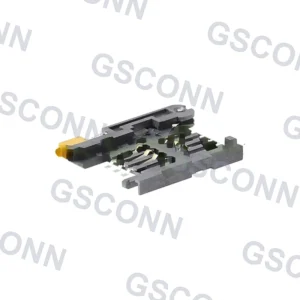
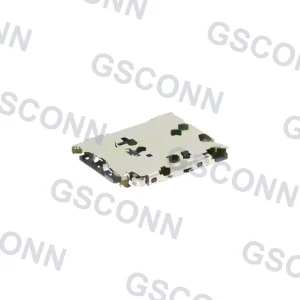
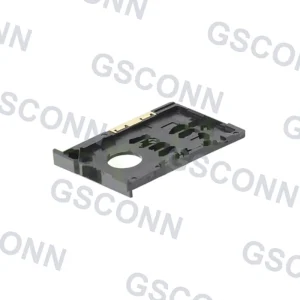
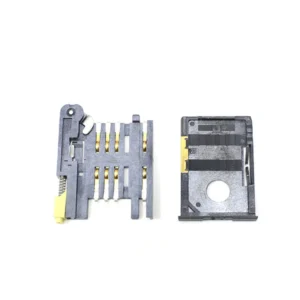
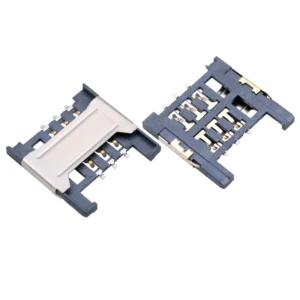
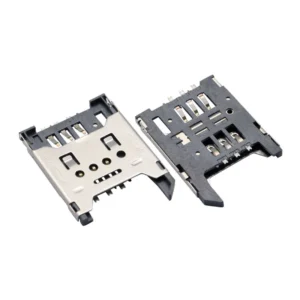
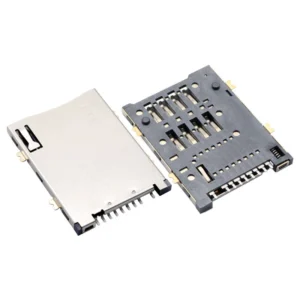
SIM Card Socket Ejector Comparison: Push-Push vs Push-Pull vs Hinged Cover

The mechanism, not the contact, decides when a SIM socket dies
A SIM socket is two products in one housing: a set of spring contacts and a mechanism that holds and releases a card. The contacts are well understood. They are rated, tested, and specified. The mechanism is usually chosen from a dropdown on a distributor page, on the basis of a single word: push-push, push-pull, or hinged.
That word decides the failure mode of the product. A socket whose contacts are rated for 10,000 cycles will still generate RMAs at cycle 400 if the latch spring fatigued, because the user cannot insert the card any more. The contact rating was never the binding constraint.
This article compares the three mechanisms on the dimensions that determine field behaviour: retention force, release behaviour, wear location, and the conditions under which each one is the wrong choice.
How each mechanism actually holds a card
The three mechanisms use fundamentally different retention principles, and that difference explains everything downstream.
| Mechanism | Retention principle | Release | Force direction under shock |
|---|---|---|---|
| Push-push | A stamped latch spring engages a notch or the card edge | Second push releases the latch, an eject spring pushes the card out | Latch must resist the eject spring plus inertia |
| Push-pull | Friction between the card and the housing walls, plus contact normal force | Direct pull on the card edge | Nothing resists motion except friction |
| Hinged cover | A lid clamps the card against the contact block | Open the lid, lift the card | The lid and its latch resist motion |
The push-push design is the only one where the retention element is also a moving, wearing part. The latch spring flexes twice per insertion (once to engage, once to release). A push-pull socket has no moving retention part at all — the housing walls are static. A hinged cover has one moving part, but it moves once per access, not twice.
That is why cycle-for-cycle, the push-push mechanism wears faster than the contacts it is supposed to protect.
Retention force: what to measure and what the datasheet does not tell you
Retention is usually specified as a minimum pull-out force. The number is useful, but it hides the more important question: how much of that force comes from the mechanism versus the contacts?
| Mechanism | Typical retention force | Source of the force | Does it degrade with cycles? |
|---|---|---|---|
| Push-push | 5–15 N | Latch engagement plus contact normal force | Yes — latch spring relaxes and the notch wears |
| Push-pull | 2–6 N | Friction plus contact normal force | Yes — housing walls polish and friction falls |
| Hinged cover | 15–40 N (lid closed) | Lid clamp force | Only if the lid latch or hinge wears |
A push-pull socket at 4 N of retention is not a robust design. It is a design that works on a bench and fails in a vehicle. The force is dominated by friction between moulded plastic and a card, and both surfaces polish with use. After a few hundred cycles the retention can fall below the force needed to resist vibration.
Hinged covers have retention an order of magnitude higher because the lid is a lever clamping the card against a rigid block. That is not a refinement; it is a different class of retention.
Shock and vibration: the analysis people skip
A card in a socket is a mass on a spring. Under shock, the card experiences acceleration and the retention mechanism must supply the force to keep it in place.
For a 0.4 g nano-SIM card and a 50 g shock pulse, the inertial force is roughly 0.2 N. That sounds trivial. It is not, because it acts in the release direction, and in a push-push socket the release direction is resisted by a latch spring that has already been cycled hundreds of times.
| Condition | Inertial force on a 0.4 g card | Implication by mechanism |
|---|---|---|
| Handling shock, 20 g | ~0.08 N | No mechanism affected |
| Transport shock, 50 g | ~0.2 N | Push-pull marginal if retention has fallen below 1 N |
| Drop, 500 g | ~2.0 N | Push-pull releases; push-push may release if the latch is worn |
| Sustained vibration, 10 g at 200 Hz | Cyclic, ~0.04 N | Push-pull card creeps out over hours; hinged cover unaffected |
The vibration row is the one that produces field failures nobody can reproduce. A push-pull socket in a vibrating assembly does not eject the card. The card walks out by fractions of a millimetre per hour until the contacts no longer align, and then the device reports intermittent card errors. On a bench with the unit sitting still, it never happens.
If the product vibrates continuously — a pump controller, a vehicle module, a machine-mounted gateway — push-pull is the wrong mechanism regardless of its cycle rating.
Wear location and what it costs to fix
| Mechanism | First thing to wear | Symptom | Field fix |
|---|---|---|---|
| Push-push | Latch spring, then the card-edge notch | Card will not stay in, or will not come out | None — socket replacement |
| Push-pull | Housing wall friction surfaces | Progressive card creep, intermittent contact | None — add external retention |
| Hinged cover | Lid latch or hinge pin | Lid does not stay closed; card lifts | Sometimes the lid is a separate part |
The push-push failure is the most expensive because there is no field remedy. The socket is soldered to the board. A card that will not latch means the unit goes back, and the repair is a board rework or a replacement.
The hinged-cover failure is cheaper because the lid is often a separate moulded part that can be replaced, and because a lid that will not latch usually still holds the card well enough to function until service.
The decision framework
Two variables decide the mechanism: how often the card is removed, and whether the person removing it is the end user or a technician.
| Removal pattern | Who removes | Recommended | Why |
|---|---|---|---|
| Never (factory-fitted) | Nobody | Drop-in or push-pull | No mechanism needed; lowest cost and height |
| Once at installation | Installer | Hinged cover | Positive retention, no latch to fatigue |
| Occasionally for service | Technician | Hinged cover | Technician will close the lid correctly; retention matters more than speed |
| Regularly by the user | End user | Push-push | Single-hand operation, no loose parts |
| Frequently, in a sealed device | End user | Tray | Seal is in the tray, not the socket |
The third row is where most industrial products belong and where most of them get it wrong. A technician changing a SIM once a year does not need push-push convenience. What the product needs is a mechanism that will still be holding the card in five years, and that is the hinged cover.
Height and board-space consequences
| Mechanism | Typical height above PCB (nano SIM) | Access requirement | PCB keep-out |
|---|---|---|---|
| Push-push | 1.25–1.5 mm | Card must be able to travel in and out; clear space beyond the socket edge | Socket footprint plus card stroke |
| Push-pull | 1.4–2.0 mm | Finger access to the card edge | Socket footprint plus pull clearance |
| Hinged cover | 2.2–3.0 mm closed, more when open | Lid must open fully; needs clearance above | Socket plus lid swing envelope |
The hinged cover costs height twice: once when closed, and again in the swing envelope when open. In a thin handheld device that rules it out. In a control cabinet with 20 mm of clearance above the board, it costs nothing.
The push-push socket also needs clear space beyond its edge for the card to travel during ejection. That clearance is frequently forgotten until the enclosure is designed and the card cannot come out.
Specification checklist
| Requirement | What to state | Why |
|---|---|---|
| Mechanism | Named type, not “SIM socket” | The mechanism sets the failure mode |
| Retention force | Minimum, measured after rated cycles | Virgin-part values hide wear |
| Cycle rating | Mechanism cycles, separate from contact cycles | The mechanism usually fails first |
| Shock | Stated in g, with the card installed | Retention is the constraint, not the contacts |
| Vibration | Sweep plus dwell, card installed | Push-pull creep only appears under dwell |
| Card stroke clearance | Millimetres beyond the socket edge | Ejection needs room the footprint does not show |
| Lid swing envelope | Height needed when open | Hinged covers need clearance above |
Specifying the mechanism by name and requiring retention data after cycling removes most of the ambiguity. A supplier who cannot provide post-cycle retention data is telling you the part was never characterised that way.
FAQ
Which mechanism lasts longest? The hinged cover, because it has one moving part that actuates once per access rather than twice. Push-push has the shortest mechanism life of the three despite often carrying the highest contact cycle rating.
Is push-pull acceptable for a fixed installation? Yes, if the card is fitted once and the assembly does not vibrate. It is the lowest-cost option and has no latch to fatigue.
Why does the card keep working loose in a vibrating machine? Push-pull retention depends on friction, and friction falls as the surfaces polish. The card creeps out slowly instead of ejecting, which produces intermittent rather than total failure.
Can a worn push-push latch be repaired? No. The latch is part of the soldered socket. The unit needs board rework or replacement.
Does a hinged cover need more board space? It needs vertical clearance for the lid to open, not more footprint. In a low-profile handheld that is disqualifying; in a cabinet with headroom it is irrelevant.
What cycle count should I require? Match it to the removal pattern: tens of cycles for factory-fitted, hundreds for field service, thousands only for consumer devices where the user swaps cards. State the requirement for the mechanism separately from the contacts.
SIM Card Connectors for this design
View all 41 parts →