
DuPont vs JST vs IDC: Prototype to Production Connector Guide
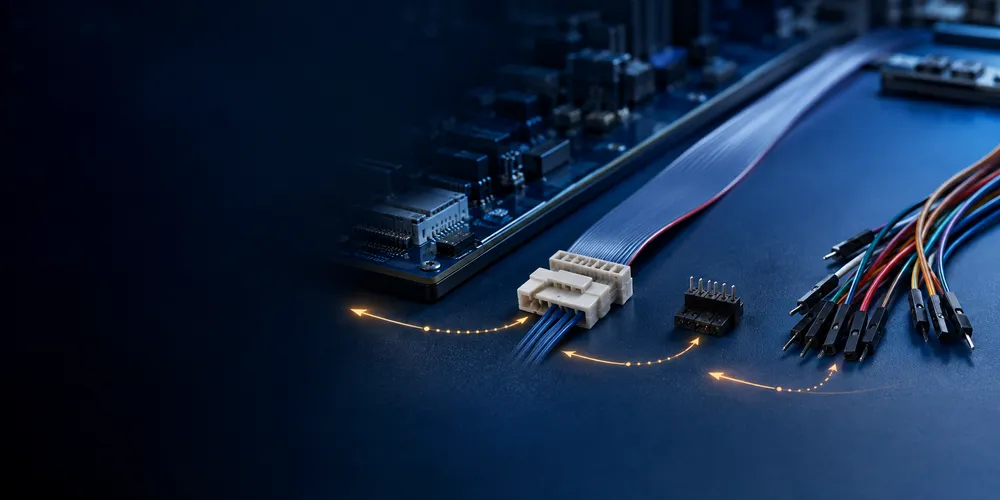
> Migration rule: A 2.54 mm prototype header cannot be exchanged for a JST or Molex connector without a PCB and harness change. Verify footprint, header orientation, keying, terminal and cable assembly together.
Quick Comparison
| Feature | DuPont | JST (PH/XH) | IDC |
|---|---|---|---|
| Pitch | 2.54mm | 2.0–2.5mm | 2.0–2.54mm |
| Locking | ❌ None (friction) | Series-dependent friction lock or latch | ⚠️ Cover/polarization varies by series |
| Retention | Very poor (1–2N) | Good (20–30N) | Medium |
| Cost per connection | Lowest | Low | Low |
| Tool required | None (or basic crimper) | Crimp tool | IDC press |
| Reworkable | ✅ Easy | ⚠️ Moderate | ❌ Single-use |
| Vibration resistance | ❌ Poor | ✅ Good | ⚠️ Fair |
| Production ready | ❌ No | ✅ Yes | ✅ Yes (ribbon cable) |
| Best for | Prototyping | Production (point-to-point) | Production (ribbon cable) |
1. DuPont Connectors: Prototype Only
DuPont connectors (2.54mm single-pin housings) slide onto standard pin headers. They’re the universal prototyping connector for Arduino and breadboard work.
What DuPont Is Good At
| Advantage | Detail |
|---|---|
| Zero cost | Nearly free, universally available |
| Instant | No crimp tool — pins slide onto headers |
| Flexible | Reconfigure pins freely, one at a time |
| Breadboard compatible | 2.54mm = 0.1″ standard |
Why DuPont Fails in Production
| Failure | Consequence |
|---|---|
| No locking | Connector falls off from cable weight or vibration |
| Loose retention | 1–2N force disconnects it |
| Inconsistent contact | High and variable contact resistance |
| Looks unprofessional | Exposed pins, no keying, wrong-way insertion possible |
| No strain relief | Wire pulls out of crimp under tension |
Rule: DuPont is for prototype validation and temporary connections. Any product that ships should use JST, IDC, Molex, or another production-grade connector. The transition from DuPont to JST is a key step in prototype-to-production.
2. JST Connectors: Production Point-to-Point
Real Parts for the Migration BOM
| Stage / need | Manufacturer example | What it demonstrates |
|---|---|---|
| Compact two-wire production link | JST PH PHR-2 + SPH-002T-P0.5S + matching PH header |
A 2.0 mm crimp system, not a 2.54 mm drop-in replacement |
| Low-power 2.5 mm link | JST XH XHP-2 + SXH-001T-P0.6 + B2B-XH-A |
A controlled housing/terminal/header set |
| Dense 1.0 mm link | JST SH SHR-02V-S + SSH-003T-P0.2-H + BM02B-SRSS-TB |
Fine-pitch signal interconnect requiring dedicated process control |
| Ribbon cable | 3M IDC 89110-0101HA |
A 10-contact IDC socket for the specified ribbon cable format |
Reference the manufacturer sources for PH, XH, SH, and 3M 891 IDC.
JST connector families are common production alternatives to DuPont-style jumpers. The exact series determines whether the interface is friction-lock, positively latched, polarized and suitable for the required cable load or vibration.
DuPont → JST Migration
| DuPont Setup | JST Replacement | Why |
|---|---|---|
| 2.54mm header + DuPont jumpers | JST XH (2.5mm) | Locked, keyed, reliable |
| Single-wire connections | JST PH (2.0mm) | Compact, latched |
| High-density signals | JST SH (1.0mm) | Tiny footprint |
| Power connections | JST VH (3.96mm) | Higher current |
Migration Benefits
| Metric | DuPont | JST |
|---|---|---|
| Retention | 1–2N | 20–30N |
| Wrong-way insertion | Possible | Impossible (keyed) |
| Contact resistance | Variable, high | <20mΩ consistent |
| Vibration | Fails | Withstands |
| Production assembly | Manual, slow | Crimped, semi-automated |
3. IDC Connectors: Production Mass Termination
IDC connectors terminate ribbon cable (10–64 conductors) in one press. They’re for multi-wire parallel connections, not point-to-point.
When IDC Beats JST
| Scenario | IDC | JST |
|---|---|---|
| 10+ parallel wires | ✅ One press | ❌ 10 individual crimps |
| Ribbon cable | ✅ Native | ❌ Not designed for |
| Speed (10+ circuits) | 2–3 sec total | 10–20 sec × 10 = 100–200 sec |
| Internal board-to-board wiring | ✅ Standard | ⚠️ Possible but bulkier |
When JST Beats IDC
| Scenario | JST | IDC |
|---|---|---|
| Individual point-to-point wires | ✅ | ❌ (overkill) |
| Rework / reconfiguration | ✅ De-pin possible | ❌ Single-use |
| Non-uniform wire routing | ✅ Flexible | ❌ Ribbon cable only |
| <5 circuits | ✅ Simple | ⚠️ Wasteful |
4. Decision Flow: Prototype to Production
“`
Current stage?
│
├── Prototype (breadboard) → DuPont header
│
├── Prototype (custom PCB)
│ ├── Temporary connections → DuPont (still fine for validation)
│ └── Test point / debug → Pin header + DuPont or pogo pins
│
├── Production design
│ ├── Point-to-point (<10 wires) → JST (PH/XH/SH by pitch)
│ ├── Parallel ribbon (10+ wires) → IDC
│ ├── Power (>3A) → Molex Micro-Fit/Mini-Fit
│ └── High density → JST SH/GH or FPC connector
│
└── Production (final)
└── JST-compatible or Molex-compatible (GSConn W2B series)
“`
5. GSConn Prototype-to-Production Migration
| Prototype (DuPont) | Production (GSConn) | Compatible With |
|---|---|---|
| 2.54mm header + jumpers | W2B-XH (2.5mm) | JST XH |
| Single signal wires | W2B-PH (2.0mm) | JST PH |
| Dense signals | W2B-SH (1.0mm) | JST SH |
| Power | W2B-MF3 (3.0mm) | Molex Micro-Fit 3.0 |
| Ribbon cable | W2B-IDC (2.54mm) | Box header standard |
Any claimed equivalent must be qualified against the exact original drawings and samples. Do not state “no PCB redesign” unless the pad pattern, mechanical envelope, mating geometry, electrical limits and validation results have been documented for the exact two parts.
GSConn wire-to-board connectors provide a clean path from prototype to production: DuPont for breadboarding, JST-compatible (PH/XH/SH) for point-to-point production, Molex-compatible (Micro-Fit/Mini-Fit) for power, and IDC for ribbon cable. All are footprint-compatible with industry standards for drop-in migration.
Related reading:
Related GSConn guides
Related reading on GSConn that complements wire-to-board-dupont-jst-idc: