
Waterproof USB Connector: IP67/IP68 Rating Explained
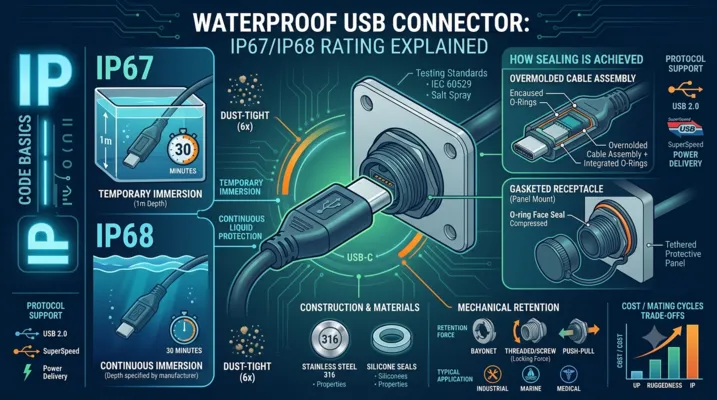
Waterproof USB Connector: IP67/IP68 Rating Explained
Introduction
Standard USB connectors fail in wet, dusty, or washdown environments. A single drop of water across the VBUS and CC pins can trigger false PD negotiation, short the power rail, or corrode contacts over time. Industrial, marine, outdoor, and medical applications demand connectors that keep moisture and particulates out — without sacrificing the USB-C ecosystem’s advantages.
This article explains what IP67 and IP68 ratings actually mean for USB connectors, how waterproof USB connectors achieve their sealing, the trade-offs involved (cost, size, mating cycles), and how to select the right sealed connector for a given application.
1. IP Code Basics: What IP67 and IP68 Actually Mean
The IP (Ingress Protection) code is defined by IEC 60529. It uses two digits:
- First digit (0-6): Protection against solid objects and dust
- Second digit (0-9): Protection against liquids
| First Digit | Protection Level |
|---|---|
| IP5x | Dust-protected (limited ingress, no harmful deposits) |
| IP6x | Dust-tight (no ingress of dust) |
| Second Digit | Protection Level |
|---|---|
| IPx4 | Splashing water, any direction |
| IPx5 | Water jets (6.3mm nozzle, 12.5 L/min) |
| IPx6 | Powerful water jets (12.5mm nozzle, 100 L/min) |
| IPx7 | Temporary immersion (1m depth, 30 minutes) |
| IPx8 | Continuous immersion (depth and duration specified by manufacturer) |
| IPx9K | High-pressure, high-temperature water jets (DIN 40050-9) |
IP67
IP67 means the connector is dust-tight (6) and protected against temporary immersion in 1 meter of water for 30 minutes (7). This is the most common rating for outdoor USB connectors — sufficient for rain, snow, temporary flooding, and washdown.
IP68
IP68 is dust-tight (6) plus protection against continuous immersion beyond 1 meter. The critical detail: IP68 depth and duration are specified by the manufacturer, not by the IEC standard. One IP68 connector might be rated for 2 meters / 24 hours; another might be 10 meters / 7 days. Always check the manufacturer’s specific test conditions.
IPx9K
IP69K is an automotive/industrial extension (not part of IEC 60529 proper, but widely referenced) for high-pressure steam cleaning: 80°C water at 80-100 bar, sprayed from multiple angles. Relevant for food processing and heavy equipment.
2. How Waterproof USB Connectors Achieve Sealing
2.1 Gasketed Receptacles (Panel Mount)
The most common approach for equipment panels and enclosures:
- O-ring face seal: A silicone or EPDM O-ring sits between the connector flange and the enclosure wall. Compression from mounting screws creates the seal. This protects the enclosure interior from water ingress around the connector body.
- Connector-to-plug seal: When the mating plug is inserted, a secondary O-ring or gasket on the plug body seals against the receptacle housing, protecting the electrical contacts.
- Unmated protection: A tethered or screw-on protective cap seals the receptacle when no cable is attached. This is essential — an IP67 receptacle without a cap is only IP67 when mated.
2.2 Overmolded Cable Assemblies
For cable-to-cable or cable-to-device connections:
- Overmolding: The connector body and cable junction are encased in a single thermoplastic or thermoset overmold. This eliminates the cable entry point as a leak path.
- Integrated O-rings: The mating face includes a compression seal activated when the connector halves are joined.
- Potting: For in-line connectors, the internal cavity behind the contacts is filled with epoxy or silicone potting compound, creating a secondary moisture barrier if the outer seal fails.
2.3 IP-Rated USB-C vs. USB-A
USB-A connectors are inherently harder to waterproof than USB-C:
| Factor | USB-A | USB-C |
|---|---|---|
| Connector shape | Rectangular with open cavity | Slim, symmetrical oval |
| Seal geometry | Complex — requires custom gasket | Simpler — uniform perimeter |
| Pin exposure | Exposed pins in receptacle | Shielded contacts inside shell |
| Waterproof variants | Available but bulky | Available in compact form factors |
| Mating cycle durability | Seals wear faster due to insertion force | Lower insertion force, less seal wear |
USB-C’s symmetrical design and internal contact arrangement make it more amenable to compact IP-rated designs. This is one reason the industry is shifting toward USB-C for ruggedized applications.
3. Construction and Materials
3.1 Contact Materials
Standard USB connectors use phosphor bronze contacts with selective gold plating (typically 0.76 µm or 30 µ” gold over nickel). Waterproof connectors add:
- Thicker gold plating: 1.27 µm (50 µ”) or more for corrosion resistance
- Stainless steel contacts: Some designs use stainless steel for the outer shell and mechanical components
- Palladium-nickel underplate: Alternative to nickel for enhanced corrosion resistance in salt spray environments
3.2 Housing Materials
| Material | Properties | Typical Application |
|---|---|---|
| Stainless steel 316 | Excellent corrosion resistance, high strength | Marine, offshore, chemical plants |
| Nickel-plated brass | Good corrosion resistance, lower cost | Outdoor industrial, signage |
| Glass-filled nylon | Lightweight, dielectric, moderate strength | Consumer outdoor, agriculture |
| Zinc alloy die-cast | Cost-effective, good strength | General industrial |
3.3 Seal Materials
| Material | Temperature Range | Key Properties |
|---|---|---|
| Silicone (VMQ) | -55°C to +200°C | Excellent compression set, UV resistant |
| EPDM | -50°C to +150°C | Good water/steam resistance, poor oil resistance |
| Nitrile (NBR) | -30°C to +100°C | Good oil resistance, moderate water resistance |
| Fluorosilicone (FVMQ) | -55°C to +175°C | Fuel/oil resistant, expensive |
| FKM (Viton) | -20°C to +200°C | Excellent chemical resistance, high cost |
For most outdoor USB applications, silicone seals offer the best balance of temperature range, UV resistance, and cost.
4. Mechanical Retention: Keeping the Seal Intact
A waterproof seal is only effective if the connector halves remain securely mated. Standard USB-C relies on friction fit — fine for office environments, but inadequate where vibration, cable strain, or accidental pull forces are present.
4.1 Bayonet Locking
- Quarter-turn bayonet coupling with spring-loaded detent
- Quick connect/disconnect (under 2 seconds)
- Audible/tactile confirmation of full mating
- Typical retention force: 100-200 N
4.2 Threaded/Screw Locking
- M8, M12, or custom threaded coupling rings
- Highest retention force (300-500 N+)
- Slower mating than bayonet but more secure
- Common in MIL-DTL and industrial circular connector standards
4.3 Push-Pull with Latch
- Self-latching mechanism, release by pulling back a sleeve
- Fastest connect/disconnect
- Moderate retention (50-150 N)
- Common in medical and instrumentation applications
4.4 Panel-Mount Flange
- Connector body bolts to an enclosure panel
- Provides structural mounting independent of the seal
- Essential for connectors that experience cable strain
5. Mating Cycles and Seal Life
Waterproof connectors trade some mechanical durability for environmental protection:
| Connector Type | Typical Mating Cycles | Notes |
|---|---|---|
| Standard USB-C | 10,000 | Per USB-IF specification |
| IP67 USB-C (consumer) | 3,000-5,000 | O-ring friction reduces cycle life |
| IP67 USB-C (industrial) | 500-2,000 | Heavier seals, bayonet/threaded coupling |
| IP68 USB-C (marine/military) | 250-1,000 | Metal shells, robust sealing |
The seal itself is the wear item. O-rings and gaskets lose elasticity over time, especially when exposed to UV, ozone, or extreme temperatures. For applications with frequent connect/disconnect, consider connectors with user-replaceable seal kits.
6. USB Protocol Support in IP-Rated Connectors
Waterproofing is a mechanical design challenge — it does not inherently limit which USB protocols the connector can support. However, practical constraints apply:
6.1 USB 2.0 (480 Mbps)
The most common configuration for waterproof USB connectors. USB 2.0 requires only 4 contacts (VBUS, GND, D+, D-), making it easier to fit into a compact sealed housing. Most industrial waterproof USB connectors are USB 2.0.
6.2 USB 3.x / SuperSpeed (5-20 Gbps)
Waterproof USB 3.x connectors exist but face challenges:
– SuperSpeed differential pairs require tighter impedance control, which is harder to maintain through a sealed connector body
– The additional contacts (8 SuperSpeed + 2 SBU) increase connector size
– Signal integrity at 5-10 GHz through a connector with seals and metal housing is more complex
– Available, but less common and more expensive than USB 2.0 IP-rated connectors
6.3 USB Power Delivery
PD communication uses the CC pin (300 kHz BMC), which is relatively low-frequency and tolerant of connector impedance variations. IP-rated USB connectors generally support PD up to 100W (20V/5A). EPR (240W at 48V) in waterproof connectors is emerging but requires careful creepage and clearance design to prevent tracking across wet seal surfaces.
6.4 DisplayPort Alt Mode / USB4
Rare in current IP-rated products. The full 24-pin USB-C interface with all SuperSpeed pairs active is mechanically complex to seal while maintaining signal integrity. As USB4 adoption grows, expect more IP-rated full-featured USB-C connectors to appear — particularly for outdoor digital signage, marine navigation displays, and industrial HMI panels.
7. Application-Specific Selection Guide
| Application | Recommended Rating | Connector Type | Key Requirements |
|---|---|---|---|
| Outdoor kiosk / digital signage | IP67 | Panel-mount USB-C, bayonet lock | UV-resistant seal, vandal-resistant |
| Agricultural equipment | IP67 / IP69K | Panel-mount with protective cap | Chemical resistance, high-pressure washdown |
| Marine electronics | IP68 | Threaded coupling, 316 stainless | Salt spray resistance, 2m+ immersion |
| Food processing | IP69K | Stainless steel, sanitary design | High-temp washdown, no crevices |
| Medical devices | IP67 | Push-pull latching | Sterilization compatibility, frequent mating |
| Industrial automation | IP67 | M12 threaded or bayonet | Vibration resistance, 24/7 operation |
| EV charging stations | IP67 | Panel-mount USB-C | Outdoor UV, vandal resistance, PD support |
| Mining / heavy equipment | IP68 | Threaded metal shell | Extreme vibration, dust, moisture |
8. Testing and Validation
8.1 Standard IP Tests (IEC 60529)
- IP6X dust test: Connector placed in a dust chamber with talcum powder for 8 hours while under vacuum. No dust ingress permitted.
- IPX7 immersion test: Connector immersed in 1 meter of water for 30 minutes. No water ingress permitted.
- IPX8 immersion test: Manufacturer-specified depth and duration. Continuous immersion test.
8.2 Additional Tests for Ruggedized USB
- Salt spray (IEC 60068-2-11): 48-96 hours in 5% NaCl fog at 35°C
- Thermal shock (IEC 60068-2-14): Rapid cycling between -40°C and +85°C
- Vibration (IEC 60068-2-6): 10-500 Hz sweep, 10g acceleration
- Mechanical shock (IEC 60068-2-27): 50g, 11ms half-sine pulse
- Cable flex / strain relief: Repeated bending at cable exit point
8.3 Real-World Validation
Lab tests are necessary but not sufficient. Common field failure modes include:
– Seal compression set after prolonged mating (connector left plugged in for months)
– O-ring swelling from chemical exposure (cleaning agents, hydraulic fluid)
– UV degradation of exposed seal surfaces
– Condensation inside sealed cavities due to thermal cycling (“breathing”)
For critical applications, specify connectors that have been validated in similar environmental conditions, not just to the IP rating alone.
9. Cost Considerations
Waterproof USB connectors cost significantly more than their standard counterparts:
| Type | Approximate Cost Multiplier | Main Cost Drivers |
|---|---|---|
| Standard USB-C connector (PCB mount) | 1x (baseline) | High volume, commodity |
| IP67 USB-C (consumer) | 3-5x | Seals, overmolding, testing |
| IP67 USB-C (industrial panel mount) | 5-15x | Metal housing, custom seals, lower volume |
| IP68 USB-C (marine/military) | 15-50x | 316 SS, precision machining, MIL-spec testing |
The cost is not just the connector — waterproofing adds cost to the entire assembly: enclosure sealing, cable overmolding, protective caps, and assembly labor. Budget for the system-level cost of environmental protection, not just the connector BOM.
10. Future Trends
- USB-C IP67 becoming mainstream: As USB-C displaces USB-A in industrial equipment, IP-rated USB-C connectors will follow the same cost-reduction curve that USB-A experienced.
- Single-cable IP-rated solutions: Combining power (PD 3.1), data (USB4), and video (DP Alt Mode) over one waterproof cable reduces enclosure penetrations and failure points.
- Wireless alternatives: For applications where even IP68 is insufficient (permanently submerged, sterile environments), Qi and NFC wireless charging + Wi-Fi/BLE data transfer are replacing physical connectors entirely.
- Smart connectors: Integrated humidity sensors that detect seal failure before water reaches the contacts, reporting status over the CC line.
FAQ
Q: Can I make a standard USB-C connector waterproof?
A: Not reliably. Adding external sealing (heat shrink, silicone tape, potting) may work temporarily but lacks the engineered seal geometry, material compatibility, and validation of a purpose-built IP-rated connector. For anything beyond temporary splash protection, use an IP-rated connector.
Q: Does IP68 automatically mean the connector is also IP67?
A: Not necessarily. IPX8 tests continuous immersion, but does not automatically cover the IPX7 temporary immersion test or IPX6 water jet test. However, most reputable manufacturers design IP68 connectors to also meet IP67. Always check the datasheet for all claimed ratings.
Q: How often should seals be replaced?
A: Depends on environment and mating frequency. As a general guideline: inspect seals annually, replace every 2-3 years in outdoor applications, or every 500-1,000 mating cycles for frequently connected equipment. Connectors with user-replaceable O-ring kits simplify maintenance.
Q: Are there waterproof USB-C connectors that support 240W PD?
A: At the time of writing, IP-rated USB-C connectors supporting full EPR (48V/5A) are rare. The creepage distance requirements at 48V are challenging in a compact sealed connector. 100W (20V/5A) IP-rated USB-C is widely available. Expect EPR-rated waterproof connectors as the 240W ecosystem matures.
Q: What is the difference between “waterproof” and “water-resistant” in connector marketing?
A: “Water-resistant” typically means IPx4 or IPx5 (splash/jet protection) and is not suitable for immersion. “Waterproof” generally implies IPx7 or IPx8. Look for the specific IP rating, not marketing terms.
References: IEC 60529 (Degrees of Protection Provided by Enclosures), USB Type-C Cable and Connector Specification R2.4, IEC 62680-1-3:2024, IEC 60068 Environmental Testing Standards.