
Wire-to-Board Connector Selection Guide: Complete Engineer’s Reference
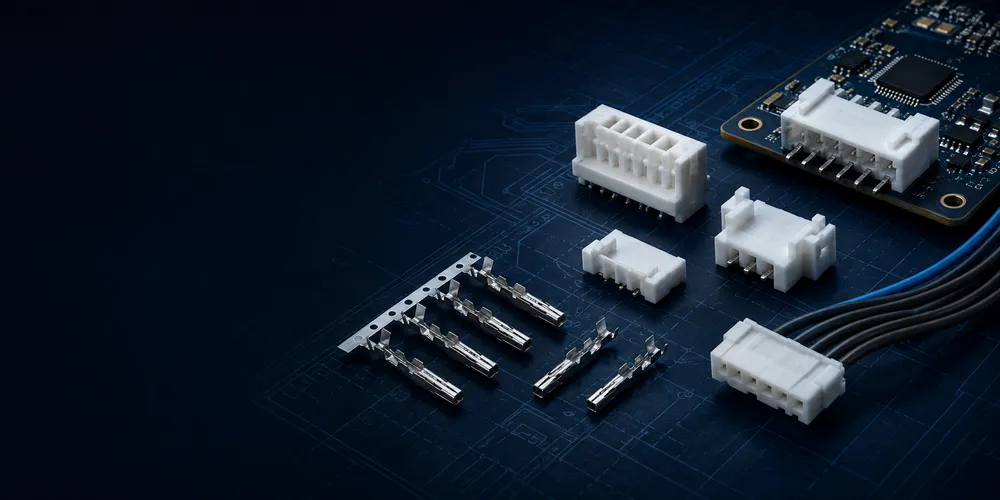
> Selection note: Current, temperature, wire range and mating-cycle figures are system-specific. Confirm the exact housing, terminal, header, wire and derating conditions in the manufacturer data sheet before release.
Quick Decision Matrix
| If you need… | Choose This Type | Typical Pitch | Best For |
|---|---|---|---|
| Small signals, consumer device | JST PH / XH / SH | 1.0–2.5mm | Sensors, motors, LEDs, drones |
| High current power (5–13A) | Molex Micro-Fit / Mini-Fit | 3.0–4.2mm | Battery packs, power tools, industrial |
| Fast mass termination | IDC Connector | 2.0/2.54mm | Ribbon cable, internal wiring |
| Prototype / breadboard | DuPont Header | 2.54mm | Arduino, development, testing |
| Vibration / harsh environment | Locking / Latching W2B | 2.0–3.0mm | Automotive, drones, industrial equipment |
| Wire-to-wire (not PCB) | In-line connector | Varies | Extension cables, harness splicing |
1. The Four Termination Methods
Wire-to-board connectors differ primarily in how the wire attaches to the terminal:
| Method | How It Works | Tool | Speed | Reliability | Cost |
|---|---|---|---|---|---|
| Crimp | Metal terminal crimped onto wire, inserted into housing | Crimp tool | Medium | Highest | Tool cost, low per-unit |
| IDC | Blade slices wire insulation, contacts conductor | IDC press | Fastest | Medium (not reworkable) | Lowest |
| Solder | Wire soldered directly to connector contact | Soldering iron | Slow | Good | Lowest per-unit |
| Screw clamp | Screw clamps wire (terminal block style) | Screwdriver | Slow | Good | Low |
See Crimp vs IDC vs Solder for full comparison.
2. Key Selection Parameters
| Parameter | What to Check |
|---|---|
| Pitch | Center-to-center pin spacing: 1.0, 1.25, 2.0, 2.5, 3.0, 4.2, 5.08mm |
| Current rating | Signal: 1–3A. Power: 5–13A (Micro-Fit/Mini-Fit). Match to load. |
| Wire size (AWG) | Connector terminal must accept your wire gauge (typically 20–28 AWG) |
| Locking / latch | Required for vibration or accidental pull-out |
| Polarization | Keyed housing prevents reverse insertion |
| Mating cycles | 30 (consumer) to 500+ (industrial) |
| Housing material | PA66 (standard), LCP (high-temp/reflow), PBT |
| Plating | Tin (low-cost), gold (low resistance, many cycles) |
3. Wire-to-Board Connector Families
JST Series (Consumer & Hobby Dominant)
The de facto standard for consumer electronics, drones, and hobby projects. Named by pitch:
| JST Series | Pitch | Current | Common Use |
|---|---|---|---|
| SH | 1.0mm | 1A | Micro cameras, small flight controllers |
| GH | 1.25mm | 1A | Compact sensors, battery balance leads |
| ZH | 1.5mm | 1A | Small speakers, LCD modules |
| PH | 2.0mm | 2A | Most common — sensors, small motors, LEDs |
| XH | 2.5mm | 3A | Battery packs, servos, fans |
| RCY | 2.5mm | 3A | RC battery connectors |
| VH | 3.96mm | 7A | Power distribution, appliances |
See JST Connector Types Guide for the full lineup.
Molex Micro-Fit / Mini-Fit (Power Dominant)
For applications needing >3A, Molex power connectors dominate:
| Series | Pitch | Current (per circuit) | Use |
|---|---|---|---|
| Micro-Fit 3.0 | 3.0mm | 5–8.5A | PC power, LED lighting, drones |
| Mini-Fit Jr | 4.2mm | 9–13A | ATX power, industrial, power tools |
| Mega-Fit | 5.7mm | 23–26A | High-power, battery, appliances |
See Molex Micro-Fit & Mini-Fit Guide.
IDC Connectors (Mass Termination)
Insulation displacement connectors terminate ribbon cable without stripping — blades slice through insulation to contact the conductor.
| Series | Pitch | Circuits | Use |
|---|---|---|---|
| 2.54mm IDC (box header) | 2.54mm | 10–64 | Internal wiring, PC cables |
| 2.00mm IDC | 2.0mm | 10–40 | Compact internal wiring |
| D-sub IDC | 2.77mm | 9–37 | Serial/parallel ports |
DuPont Connectors (Prototyping)
2.54mm single-pin housings that slide onto pin headers. Not a production connector — no locking, loose retention.
4. Selection Flowchart
“`
Need wire-to-board connection?
│
├── Prototype / temporary → DuPont header (2.54mm)
│
├── Consumer product, low current (<3A)
│ ├── Small / high density → JST (PH/XH/SH by pitch)
│ └── Battery / power → JST XH or RCY
│
├── Power, >3A
│ ├── 5–8A → Molex Micro-Fit 3.0
│ ├── 9–13A → Molex Mini-Fit Jr
│ └── >20A → Mega-Fit or terminal block
│
├── Mass termination (ribbon cable) → IDC connector
│
├── Vibration / automotive → Locking W2B (latch or screw)
│
└── High reliability / many cycles → Gold-plated crimp connector
“`
5. GSConn Wire-to-Board Portfolio
Verified Brand Model Examples (for BOM starting points)
The following are real manufacturer part numbers, included to make the guide actionable. They are examples, not cross-reference claims; validate footprint, keying, plating and approved wire range before substitution.
| Requirement | Manufacturer example | Typical set to verify |
|---|---|---|
| Compact 2-circuit signal connection | JST PH | PHR-2 receptacle housing + SPH-002T-P0.5S female terminal + matching PH header |
| 2.5 mm balance / low-power connection | JST XH | XHP-2 housing + SXH-001T-P0.6 terminal + B2B-XH-A header |
| 1.0 mm high-density connection | JST SH | SHR-02V-S housing + SSH-003T-P0.2-H terminal + BM02B-SRSS-TB header |
| 3.0 mm positive-lock power connection | Molex Micro-Fit 3.0 | 43045-0200 receptacle housing + 43025-0200 terminal + 43650-0200 header |
| 4.2 mm power connection | Molex Mini-Fit family | Select the Mini-Fit Jr/TPA2 housing, terminal and header as one approved system; rating varies with terminal and wire |
| 10-way 0.050 in ribbon cable | 3M IDC 891 | 89110-0101HA socket; confirm the matching header and cable construction |
Official sources: JST PH, JST XH, JST SH, Molex Mini-Fit, 3M 891 Series.
| Series | Type | Pitch | Current | Compatible With |
|---|---|---|---|---|
| W2B-PH | Crimp | 2.0mm | 2A | JST PH footprint |
| W2B-XH | Crimp | 2.5mm | 3A | JST XH footprint |
| W2B-SH | Crimp | 1.0mm | 1A | JST SH footprint |
| W2B-MF3 | Crimp | 3.0mm | 8A | Molex Micro-Fit 3.0 |
| W2B-MJ42 | Crimp | 4.2mm | 13A | Molex Mini-Fit Jr |
| W2B-IDC | IDC | 2.54mm | 1A | Box header standard |
| W2B-LK | Crimp + latch | 2.0–3.0mm | 3A | Locking, vibration-proof |
When specifying a GSConn or any alternative part, include the original and proposed housing, terminal and header on the validation plan. Approve substitution only after drawing comparison, fit/mate testing, pull testing, temperature-rise review and applicable compliance review.
Related reading:
- JST Connector Types Guide
- Crimp vs IDC vs Solder
- Molex Micro-Fit & Mini-Fit
- Wire-to-Board Pitch Guide
Related GSConn guides
Related reading on GSConn that complements wire-to-board-selection-guide: