
Wire-to-Board Connector Pitch Guide: 1.0 to 5.08mm Explained
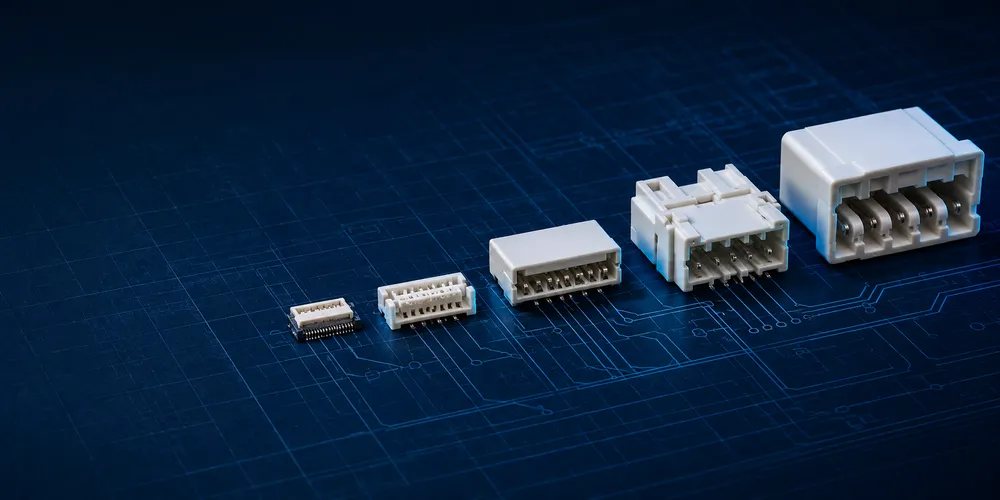
> Pitch is only the first filter. It does not guarantee electrical capability, mating compatibility or footprint interchangeability. Select the full connector system and apply the manufacturer’s derating data.
Quick Reference
| Pitch | Current (typical) | Wire AWG | Common Series | Best For |
|---|---|---|---|---|
| 0.8mm | 0.5A | 30–32 | FPC-style | Ultra-compact, wearables |
| 1.0mm | 1A | 28–32 | JST SH, Hirose DF19 | Micro cameras, sensors |
| 1.25mm | 1A | 26–30 | JST GH, Molex PicoBlade | Compact battery leads |
| 1.5mm | 1A | 26–30 | JST ZH, Molex Pico-Lock | Small modules |
| 2.0mm | 2A | 24–28 | JST PH, Molex CLIK-Mate | Universal consumer |
| 2.5mm | 3A | 22–28 | JST XH, Molex KK 254 | Battery, power |
| 3.0mm | 5–8.5A | 20–30 | Molex Micro-Fit 3.0 | Medium power |
| 3.96mm | 7A | 18–22 | JST VH | Power, appliances |
| 4.2mm | 9–13A | 16–24 | Molex Mini-Fit Jr | High current power |
| 5.08mm | 12–16A | 14–22 | Terminal block, power | Highest current |
1. What Pitch Determines
Pitch — the center-to-center distance between adjacent contacts — is the single most important wire-to-board connector parameter. It determines:
| Factor | Effect of Smaller Pitch |
|---|---|
| PCB space | Less board area per circuit |
| Current capacity | Lower (thinner contacts, closer spacing = heat accumulation) |
| Wire size | Finer wire (smaller terminal) |
| Assembly difficulty | Harder crimping, tighter tolerances |
| Cost | Higher (precision manufacturing) |
2. Choosing Pitch by Current Requirement
Pitch can be used as an early screening parameter, but it does not scale linearly with current. Contact geometry, plating, wire size, circuit count, board copper and temperature rise determine the usable current.
| Required Current | Minimum Pitch | Example Connector |
|---|---|---|
| ≤1A | 1.0mm | JST SH |
| ≤2A | 2.0mm | JST PH |
| ≤3A | 2.5mm | JST XH |
| ≤8.5A | 3.0mm | Molex Micro-Fit 3.0 |
| ≤13A | 4.2mm | Molex Mini-Fit Jr |
| ≤16A | 5.08mm | Terminal block or power connector |
| >20A | 5.7mm+ | Mega-Fit or bus bar |
Rule of thumb: Match pitch to current. Don’t use a 1.0mm connector for 2A — the contact will overheat. Don’t use a 4.2mm connector for 0.5A signal — wasteful space.
3. Choosing Pitch by Board Space
| PCB Space Constraint | Recommended Pitch | Why |
|---|---|---|
| Extreme (wearables, micro modules) | 0.8–1.0mm | Smallest footprint |
| Tight (drones, compact sensors) | 1.25–1.5mm | Good density |
| Standard (consumer electronics) | 2.0mm | Universal balance |
| Relaxed (industrial, power) | 2.5–4.2mm | Easier assembly, higher current |
4. Pitch and Wire Gauge Compatibility
Each pitch has an optimal wire gauge range. Using wire outside this range causes problems:
| Pitch | Optimal AWG | Too-Thick Wire | Too-Thin Wire |
|---|---|---|---|
| 1.0mm | 28–32 | Won’t fit in terminal | Loose crimp, poor contact |
| 2.0mm | 24–28 | Terminal overfilled | Incomplete compression |
| 2.5mm | 22–28 | — | — |
| 3.0mm | 20–30 | — | — |
| 4.2mm | 16–24 | — | — |
The terminal is designed for a specific wire gauge range. Crimping wire outside the range produces either a loose connection (too thin) or a cracked/deformed terminal (too thick).
5. Pitch Migration Strategy
Real Series and Part-Number Examples
| Pitch | Manufacturer example | Useful BOM reference | Selection caveat |
|---|---|---|---|
| 1.0 mm | JST SH | SHR-02V-S / SSH-003T-P0.2-H / BM02B-SRSS-TB |
Fine-wire process control is essential |
| 2.0 mm | JST PH | PHR-2 / SPH-002T-P0.5S |
JST specifies PH at 2 A AC/DC with AWG 24; apply project derating |
| 2.5 mm | JST XH | XHP-2 / SXH-001T-P0.6 / B2B-XH-A |
Confirm header orientation and wire range |
| 3.0 mm | Molex Micro-Fit 3.0 | 43045-0200 / 43025-0200 / 43650-0200 |
Current depends on terminal, wire and temperature rise |
| 4.2 mm | Molex Mini-Fit family | 0353182410 header example |
Build a matched Mini-Fit BOM; family rating is configuration-dependent |
Manufacturer references: JST SH, JST PH, JST XH, Molex Mini-Fit.
When redesigning a product to use a different pitch:
| From | To | Considerations |
|---|---|---|
| 2.54mm header | 2.0mm JST PH | Saves 20% board width, needs crimp tool |
| 2.5mm XH | 3.0mm Micro-Fit | Higher current, larger footprint |
| 2.0mm PH | 1.25mm GH | Higher density, finer wire needed |
| DuPont (2.54mm) | 2.0mm PH | Smaller, locked, more reliable |
Migration requires: New PCB footprint, new crimp terminals, new housing, and a crimp tool. It’s not a drop-in change.
6. GSConn Pitch Offerings
| Pitch | GSConn Series | JST/Molex Compatible |
|---|---|---|
| 1.0mm | W2B-SH | JST SH |
| 1.25mm | W2B-GH | JST GH |
| 2.0mm | W2B-PH | JST PH |
| 2.5mm | W2B-XH | JST XH |
| 3.0mm | W2B-MF3 | Molex Micro-Fit 3.0 |
| 3.96mm | W2B-VH | JST VH |
| 4.2mm | W2B-MJ42 | Molex Mini-Fit Jr |
| 5.08mm | W2B-TB | Terminal block style |
GSConn wire-to-board connectors cover 1.0mm to 5.08mm pitch with JST and Molex compatible footprints. Full range of crimp terminals, housings, and headers. Pitch migration and cross-reference support available from GSConn engineering.
Related reading:
Related GSConn guides
Related reading on GSConn that complements wire-to-board-pitch-guide: