
Molex SlimStack vs Samtec SEARAY: How to Choose a High-Density Board-to-Board Connector
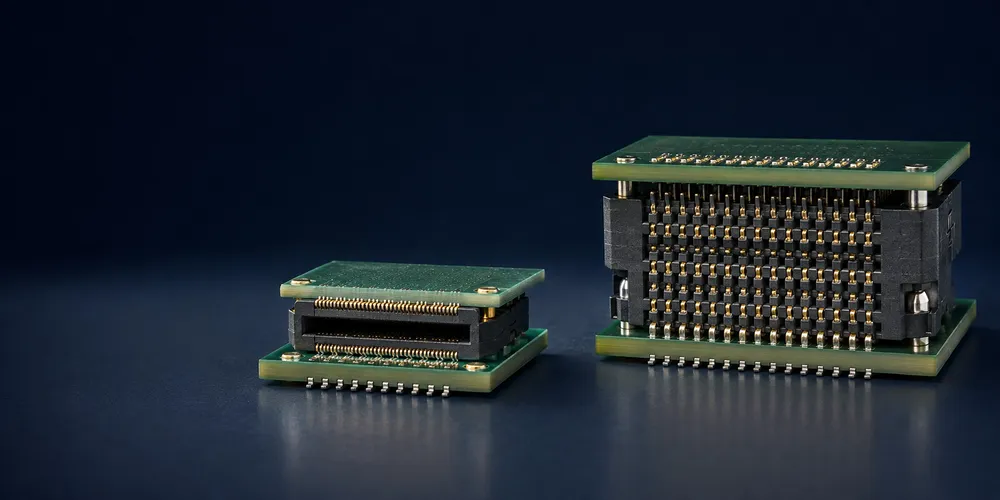
Molex SlimStack and Samtec SEARAY are both established board-to-board connector families, but they solve different packaging problems. SlimStack focuses heavily on micro/fine-pitch, low-profile board stacking, while SEARAY emphasizes high-speed, high-I/O array connectivity with flexible signal/ground pin fields. Comparing them as direct substitutes can therefore be misleading.
This guide compares the two families by architecture and then explains how to evaluate a GSCONN alternative without making unsupported “drop-in replacement” assumptions.
Key Takeaways
- SlimStack is the stronger starting point when minimum footprint and stack height dominate.
- SEARAY is the stronger starting point when high I/O count, pin-field flexibility, and modeled high-speed performance dominate.
- Pitch and circuit count do not establish footprint compatibility or equivalent channel performance.
- Any GSCONN alternative should be evaluated against an exact mating pair, drawing, test data, and qualification plan.
Quick Comparison
| Feature | Molex SlimStack | Samtec SEARAY |
|---|---|---|
| Core positioning | Micro/fine-pitch, compact board stacking | High-speed, high-density open-pin-field arrays |
| Pitch | Family includes pitches down to 0.35 mm | SEARAY families include 1.27 mm and 0.80 mm arrays |
| Height | Very low mated-height options available | Commonly taller array stack heights |
| I/O scale | Product-dependent; compact multi-circuit designs | Up to hundreds of I/Os in selected families |
| High-speed approach | Selected sub-series support high-speed interfaces | Designed around high-speed array routing flexibility |
| Best fit | Space- and height-constrained products | High-I/O computing, networking, instrumentation |
Important: specifications vary significantly by sub-series and part number. Always compare exact mating pairs, not brand-family averages.
1. Molex SlimStack: Compact and Low Profile
Molex describes SlimStack as a micro/fine-pitch board-to-board portfolio with multiple pitch, current, height, and application options. The family includes products at 0.35 mm pitch and very low mated heights, as well as floating and higher-current variants.
SlimStack is strong when you need:
- very small PCB footprint;
- low stack height;
- dense internal connections in compact products;
- many available mating-height/pitch combinations;
- specialized sub-series for battery, floating, or signal applications.
What to verify
Because “SlimStack” covers many different series, verify the exact part number for:
- circuit count;
- mated height;
- current per contact;
- operating temperature;
- durability;
- high-speed qualification;
- self-alignment and retention features.
Do not apply one current or data-rate number to all SlimStack products.
2. Samtec SEARAY: High-I/O and High-Speed Flexibility
Samtec’s SEARAY families are open-pin-field array connectors intended to give designers flexibility in assigning differential pairs, single-ended signals, power, and ground.
Samtec publishes SEARAY options with:
- very high I/O counts;
- 1.27 mm and 0.80 mm pitch families;
- high-speed performance including 56 Gbps PAM4 on selected products;
- multiple stack heights;
- ground and routing flexibility through the open pin field.
For example, Samtec’s 0.80 mm SEARAY Ultra LP family is published with up to 500 I/Os and 28 Gbps NRZ / 56 Gbps PAM4 performance. Those figures apply to the specified family and configuration, not automatically to every SEARAY part or completed PCB channel.
This architecture is especially useful in FPGA, processor, networking, instrumentation, and data-centric systems where pin-field assignment and channel performance matter more than achieving the absolute minimum connector height.
3. Why They Are Usually Not Direct Substitutes
A fine-pitch two-row mezzanine connector and an open-pin-field array differ in:
- PCB footprint topology;
- number of rows;
- pin assignment flexibility;
- mated height;
- breakout routing;
- total mating force;
- high-speed channel modeling;
- power distribution options.
Even if two parts have a similar number of contacts, swapping between them may require a full PCB and mechanical redesign.
4. Selection by Requirement
| Requirement | Better Starting Point | Reason |
|---|---|---|
| Minimum thickness / tiny module | SlimStack | Fine pitch and low-height options |
| Hundreds of I/Os | SEARAY | Large open-pin-field arrays |
| High-speed FPGA or networking board | SEARAY | Flexible high-speed pin field and models |
| Compact camera/wearable | SlimStack | Space-efficient geometry |
| High mechanical tolerance | Compare specific floating options | Capability is sub-series specific |
| Mixed power + signal | Compare exact hybrid/power-capable series | Family name alone is insufficient |
5. How to Evaluate a GSCONN Alternative
A credible second-source or alternative connector comparison must be part-number-to-part-number, not brand-to-brand.
Check all of the following:
- PCB footprint — pad dimensions, locating features, solder tabs.
- Mated height — including tolerance.
- Circuit count and pin numbering.
- Mating interface geometry — not just pitch.
- Current and voltage ratings under the relevant conditions.
- High-speed data — insertion loss, return loss, crosstalk, S-parameters.
- Mechanical durability and mating force.
- Operating temperature and material/reflow requirements.
- Qualification requirements for automotive, industrial, or other regulated applications.
- Supply and lifecycle expectations.
Only describe a connector as “drop-in” or “footprint compatible” after the drawings and qualification data demonstrate that equivalence.
6. Cost Comparison: Avoid Generic Percentages
Connector cost depends on annual volume, plating, circuit count, packaging, qualification, supplier region, and commercial agreement. Generic claims such as “30–50% cheaper” are not technically defensible without a quotation for the exact parts.
A better sourcing comparison uses total design-in cost:
- unit price;
- tooling/NRE;
- PCB redesign cost;
- qualification testing;
- supply assurance;
- lead time;
- assembly yield;
- lifecycle support.
7. Practical Decision Flow
Choose SlimStack first when the design is dominated by Z-height and board area.
Choose SEARAY first when the design is dominated by high I/O count, routing flexibility, and high-speed channel performance.
Evaluate GSCONN as an alternative when its actual product drawing and electrical/mechanical data meet the same design requirements. Treat “equivalent,” “compatible,” and “drop-in” as engineering conclusions that require verification.
FAQ
Is SEARAY always 0.8 mm pitch?
No. Samtec offers SEARAY families in different pitch architectures, including classic 1.27 mm and ultra-high-density 0.80 mm products.
Is SlimStack always limited to low current?
No. SlimStack is a broad family with signal and higher-current/battery variants. Use the exact product datasheet.
Can a GSCONN part replace SlimStack or SEARAY without PCB changes?
Only if the exact footprint, mating geometry, height, pinout, and performance have been verified. Do not assume compatibility from pitch or circuit count alone.
Related reading:
- High-Density Board-to-Board Connector Guide
- Low-Profile Board-to-Board Connector Guide
- PCB Board-to-Board Connector Design Guide
Technical References
Related reading on GSConn
- Wire-to-Board vs Board-to-Board Connectors
- Industrial USB Connector Guide
- IP67 vs IP68 USB Connector
- Stacked USB Connector Guide
- Request a Quote
Engineering references
- Product drawing, datasheet, material declaration and qualification report for the selected connector series
- IPC land-pattern and acceptability guidance applicable to the PCB assembly class
- Project-specific vibration, shock, thermal and electrical requirements