
Connector Corrosion Prevention: Plating, Seals and Testing
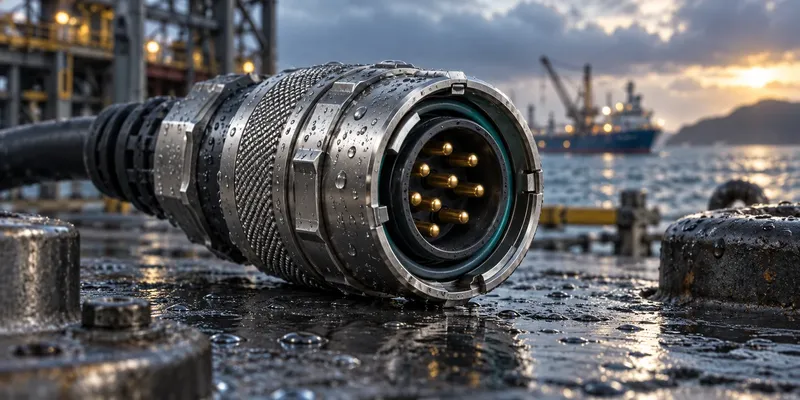
A connector can look clean and still develop an unstable electrical interface. Moisture, contamination and repeated microscopic movement can increase contact resistance long before obvious rust appears. Effective connector corrosion prevention combines a suitable contact finish, mechanical stability and protection against the actual environment.
Start with the failure mechanism. A thicker coating will not fix an inadequate cable seal, and a waterproof enclosure will not eliminate movement between contacts.
Identify the exposure before choosing a finish
| Exposure | Main concern | Design response |
|---|---|---|
| Humidity and temperature cycling | Moisture accumulation and condensation | Review enclosure breathing, drainage and seal design |
| Salt contamination | Corrosion of shells, contacts and dissimilar-metal joints | Specify compatible materials and representative corrosion testing |
| Sulfur-bearing atmosphere | Tarnishing of susceptible contact finishes | Evaluate the complete plating system using relevant gas exposure |
| Vibration or thermal expansion | Fretting wear and debris at the interface | Control contact force, retention and relative movement |
| Cleaning chemicals | Seal swelling or polymer degradation | Check compatibility with the actual fluid and cleaning process |
Choose plating as a contact system
Tin can be effective in cost-sensitive connections with suitable contact force and limited movement. Its oxide film and susceptibility to fretting must be considered; tin is not automatically unsuitable for all industrial use.
Gold is useful for low-level signals because the contact surface resists oxidation. Performance still depends on thickness, porosity, the underplate, contact geometry and wear. A thin gold flash should not be treated as a universal high-cycle or coastal specification.
Silver is widely used in power contacts, but sulfur-containing atmospheres can form tarnish films that affect performance. Select it from the supplier’s electrical and environmental data, rather than assuming tarnish is harmless or always conductive.
Palladium-nickel systems with an appropriate gold finish may offer useful wear characteristics. They are one option to evaluate, not a default replacement for every gold-plated contact. Specify both mating finishes and avoid changing only one side without validation.
Understand what an IP rating establishes
An IP rating describes protection against solid-object and water ingress under defined test conditions. It does not establish corrosion resistance, chemical compatibility, freedom from condensation or an unlimited underwater service life. The IEC explains this scope in its guide to ingress protection ratings.
Check whether the rating applies when mated, capped or installed in a particular panel. Cable diameter, gland assembly and panel seals can determine whether the installed system achieves the stated protection. IP68 conditions must be obtained from the supplier; a water-ingress claim does not make a connector suitable for wet mating.
Validate the complete assembly
Record initial contact resistance, then test representative mated assemblies with production cables and seals. Select exposure conditions to match service: salt, industrial gases, humidity, temperature cycling and vibration address different risks. Inspect shells and seals, and repeat electrical measurements after exposure.
Use defined acceptance limits for resistance change, insulation performance, leakage and mechanical function. Salt-test hours should not be converted directly into years of field life. If the equipment is serviced outdoors, include the relevant unmated exposure and recovery process in the validation plan.
FAQ
Does gold plating prevent every corrosion failure?
No. Wear, pores, exposed base metal, incompatible mating finishes and contamination can still affect the interface.
Is a sealed connector maintenance-free?
No. Seals, caps and cable jackets can deteriorate. Inspection and replacement intervals should reflect exposure and service requirements.
Prepare a corrosion-resistance enquiry
Send GSConn the mating part numbers, operating environment, cleaning fluids, cycle requirement and test acceptance criteria. Ask for part-specific plating and seal information before selecting a candidate. This makes the enquiry more useful than requesting a generic “corrosion-proof connector.”