Best SIM Card Connector for Cellular IoT Modules

There is no single best SIM socket, only the right one for the deployment
The question “which SIM connector should I use for a cellular IoT module” has a different answer for a mains-powered indoor gateway and an outdoor meter cabinet, and the difference is not a matter of preference. It comes down to three deployment variables: who has physical access to the card, how often they will use it, and what the environment does to the mechanism.
This guide is organised by deployment scenario rather than by product family, because that is how the decision is actually made. Each scenario lists the constraints that dominate, the form factor that follows, and the mechanism that survives.
The three variables that decide everything
| Variable | Question to answer | What it changes |
|---|---|---|
| Access owner | Does the end user, a field technician, or nobody touch the card? | Mechanism type and presence switch requirement |
| Access frequency | Once at commissioning, yearly, or weekly? | Cycle rating and latch durability |
| Environment | Temperature range, humidity, vibration, contamination? | Housing material, plating, retention type |
A fourth variable — certification — overrides all of these in automotive and medical applications, where the socket must be qualified to a standard regardless of how well it suits the deployment.
Scenario matrix
| Deployment | Form factor | Mechanism | Presence switch | Why |
|---|---|---|---|---|
| Indoor fixed gateway, mains powered | 4FF | Push-push | Yes | Occasional user access, controlled environment, cost sensitive |
| Outdoor cabinet / street furniture | 4FF | Hinged cover | Yes | Thermal cycling and humidity; latch fatigue is unacceptable at service intervals |
| Vehicle telematics | 4FF | Hinged cover | Yes | Continuous vibration rules out friction retention |
| Remote unattended meter | 4FF | Hinged cover | Yes | Service visits are expensive; the socket must survive 5+ years untouched |
| Handheld / portable terminal | 4FF or tray | Push-push or tray | Yes | User swaps cards; single-hand operation matters |
| High-volume consumer, factory fitted | 4FF | Drop-in / no-push | No | Card never removed; lowest cost and height |
| Sealed IP67 enclosure | 4FF | Tray | Yes | The seal lives in the tray, not the socket |
The matrix has one dominant pattern: the more expensive it is to visit the device, the more the mechanism matters and the less the unit cost matters. A hinged cover that costs a few cents more than a push-push part is trivial compared with a single site visit.
Indoor fixed gateways: cost and convenience dominate
A gateway on a wall inside a building is the easiest case. Temperature is controlled, there is no vibration, and the card is usually installed once at commissioning and left alone.
Push-push is acceptable here because the environment does not stress the latch and the access count is low. A presence switch is still worth having: it lets firmware distinguish “no card” from “card present but not registering,” which halves the diagnostic effort on support calls.
| Specification | Target |
|---|---|
| Form factor | 4FF (nano SIM) |
| Contacts | 6 + presence switch (7-pin) |
| Height | 1.3–1.5 mm |
| Operating temperature | −20 °C to +70 °C acceptable; −40 °C to +85 °C preferred for margin |
| Plating | Gold on contact area, thickness specified |
| Cycle rating | 5,000 mechanism cycles is ample |
The cost pressure in this segment is real, and the honest engineering position is that a cheaper socket is fine as long as the plating specification is not compromised. Gold thickness on the contact area is the one cost reduction that shows up as a field failure.
Outdoor and street cabinets: the mechanism is the risk
An outdoor cabinet exposes the socket to daily thermal cycling. The card, the housing, and the contacts expand at different rates, and the mechanism works slightly loose and tight once per day. Over a few years that is thousands of micro-cycles on the latch, on top of the handful of insertion cycles.
This is where push-push fails in a way that never appears in a cycle-count specification. The latch was rated for 5,000 full insertions; it sees perhaps 20. But it also sees 1,000 thermal micro-cycles per year, and the stamped spring that provides the latch force relaxes.
| Requirement | Why it matters outdoors |
|---|---|
| Hinged cover with metal latch | Clamp force does not depend on a thin spring |
| −40 °C to +85 °C rating | Cabinet internal temperature exceeds ambient |
| Gold plating, specified thickness | Condensation cycles corrode marginal plating |
| Presence switch | Remote diagnostics without a site visit |
| Drain path or sealed variant | Condensation must not pool on the contacts |
The drain path point is overlooked. A socket with a closed body and no drainage collects condensation at the bottom of the contact block. Even with gold plating, standing water plus bias voltage produces electrochemical migration over time. Either use a sealed socket inside a sealed enclosure, or provide a path for water to leave.
Vehicle and fleet telematics: vibration decides
A vehicle module sees continuous broadband vibration plus shock. Friction-retained cards creep; latch-retained cards can eject on a severe event; clamped cards do not move.
Three requirements follow:
Positive retention. A hinged cover or a locking tray. Push-pull is disqualified outright.
Extended temperature with margin. The socket must be rated beyond the cabin range because the module may be mounted in a dashboard, an engine bay adjacent enclosure, or under a seat where temperatures exceed ambient.
Automotive qualification where required. If the module is a production automotive part, the socket needs AEC-Q200 qualification. If it is an aftermarket device, the qualification is not mandatory but the temperature and vibration testing still are.
| Requirement | Vehicle-specific note |
|---|---|
| Retention | Clamped or latched; friction is not acceptable |
| Temperature | Specify −40 °C to +105 °C or better if mounted near the dashboard |
| Vibration | Random vibration per the vehicle zone, card installed, with dwell |
| Shock | Drop and crash-pulse survival with the card installed |
| Plating | Gold, with thickness; tin is not acceptable in a condensing environment |
| Qualification | AEC-Q200 if the product is a production automotive component |
Remote unattended devices: design for the visit you will not make
A water meter in a basement, a pipeline monitor on a pole, a vending telemetry unit: the economics are inverted. The socket costs cents; a site visit costs hundreds. Design for the assumption that nobody will touch the device for five years.
What that means in practice:
| Design decision | Rationale |
|---|---|
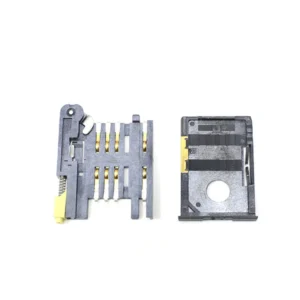
| Hinged cover, not push-push | No latch spring to relax over thermal cycles |
| Presence switch, mandatory | Remote fault isolation; saves a truck roll |
| Gold plating with stated thickness | Humidity and condensation over years |
| Wide temperature rating | Unheated enclosures track ambient extremes |
| Consider eSIM plus socket | Profile can be switched remotely; socket remains as recovery path |
The last row is the one worth arguing for. A device with only an eSIM that loses its profile and has no working backhaul cannot be recovered without a visit. A device with a physical socket can be recovered by anyone with a card. In a remote installation, that redundancy is worth more than the socket costs.
Handheld terminals: convenience is the requirement
A handheld POS terminal, a body-worn camera, a portable diagnostic tool: the user swaps cards, often with one hand, sometimes outdoors, occasionally in a hurry.
Push-push is the correct mechanism, and the design work goes into making the latch last rather than avoiding it. That means specifying the mechanism cycle rating above the expected use, requiring retention data after cycling, and providing finger access to the card so it is ejected into a hand rather than onto the ground.
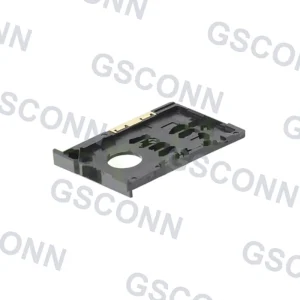
Trays are worth considering if the device is sealed. A tray moves the sealing problem to a replaceable gasket and removes the card slot from the enclosure wall.
What separates a good socket from a cheap one
| Feature | Cheap part | Specified part | Field consequence |
|---|---|---|---|
| Contact plating | Gold flash, unstated thickness | Gold with stated thickness over nickel | Intermittent contact in humidity |
| Contact force | Nominal value | Minimum, at thin card tolerance | No registration on some cards |
| Retention after cycling | Not specified | Stated minimum after rated cycles | Card ejects or creeps |
| Housing material | Unstated thermoplastic | LCP or equivalent, UL94 V-0 | Dimensional drift at temperature |
| Presence switch | Absent | Normally-open switch, debounced | No remote fault isolation |
| Temperature rating | 0 °C to +70 °C | −40 °C to +85 °C or better | Failures in cold-start conditions |
FAQ
Which SIM socket is best for an outdoor IoT device? A 4FF socket with a hinged cover, a presence switch, gold-plated contacts with stated thickness, and a −40 °C to +85 °C rating. The hinged cover matters because thermal cycling relaxes latch springs even when the card is never removed.
Is push-push ever acceptable outdoors? Only inside a sealed enclosure where the socket itself never sees condensation, and only if the card is not removed. The thermal cycling argument still applies to the latch.
Do I need a presence switch? Yes for anything deployed remotely. It converts an ambiguous “no network” symptom into a specific “no card” diagnosis without a site visit.
Should I use eSIM instead? For consumer devices with reliable connectivity, yes. For remote industrial installations, an eSIM plus a socket gives remote provisioning with a physical recovery path.
What is the minimum temperature rating for a vehicle module? −40 °C to +85 °C is a floor. Modules mounted near a dashboard or in an engine-adjacent enclosure should specify +105 °C.
Is a tray better than a socket in a sealed device? Yes. The tray moves the seal to a replaceable gasket and keeps the enclosure wall unbroken except at a designed opening.
SIM Card Connectors for this design
View all 41 parts →