
JST Connector Types: Complete Guide to PH, XH, SH, and Every Series
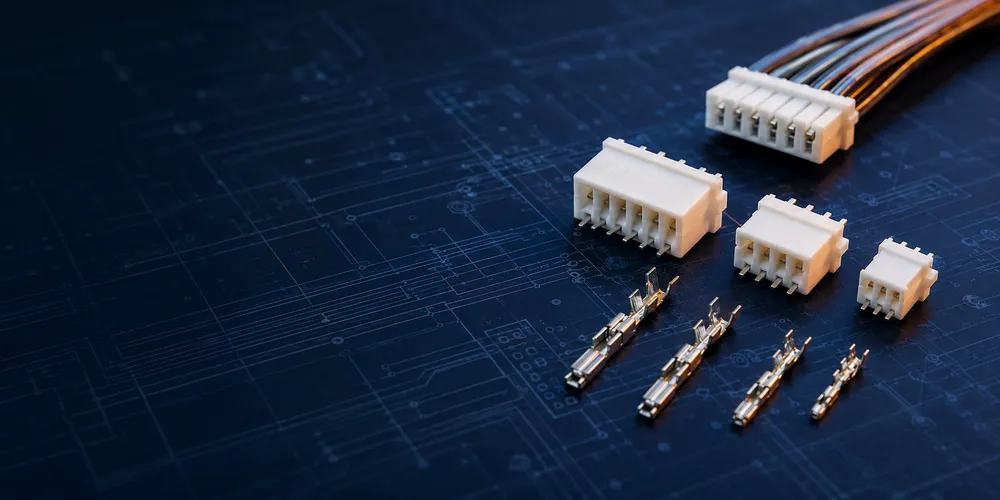
> Important: “JST-style” is not a specification. Choose the housing, terminal and header from the same approved JST series, then confirm the exact wire range and derating in the applicable data sheet.
Quick Reference — All Common JST Series
| Series | Pitch | Current | Wire AWG | Use Case |
|---|---|---|---|---|
| SH | 1.0mm | 1A | 28–32 | Micro cameras, tiny flight controllers |
| GH | 1.25mm | 1A | 26–30 | Compact sensors, battery balance leads |
| ZH | 1.5mm | 1A | 26–30 | Small speakers, LCD modules |
| PH | 2.0mm | 2A | 24–28 | Most common — sensors, motors, LEDs |
| PA | 2.0mm | 3A | 22–28 | Higher current at 2.0mm |
| XH | 2.5mm | 3A | 22–28 | Battery packs, servos, fans |
| RCY | 2.5mm | 3A | 22–28 | RC battery connectors |
| VH | 3.96mm | 7A | 18–22 | Power distribution, appliances |
| EH | 2.5mm | 3A | 22–28 | Similar to XH, older style |
| SM | 2.5mm | 3A | 22–28 | Wire-to-wire version of XH |
1. What “JST” Actually Means
JST (Japan Solderless Terminal) is a Japanese connector manufacturer. “JST connector” is often used loosely to mean “small white crimp connector,” but JST actually produces hundreds of distinct series. The key distinction: each series has a unique pitch, pin shape, and housing geometry — they are NOT interchangeable.
The most common misunderstanding: a “JST PH” connector is completely different from a “JST XH” — different pitch (2.0mm vs 2.5mm), different pin size, and the housings do not mate with each other.
How to Identify a JST Series
- Measure pitch: Center-to-center distance between adjacent pins
- Check pin shape: Round, square, or blade
- Check housing: Locking latch type, keying, dimensions
- Match the datasheet: Confirm against official JST dimensions
2. The Big Three: PH, XH, SH
JST PH (2.0mm) — The Hobby Standard
The most commonly encountered JST connector in DIY and consumer electronics.
| Parameter | Specification |
|---|---|
| Pitch | 2.0mm |
| Current | 2A |
| Wire | 24–28 AWG |
| Positions | 2–16 |
| Locking | Friction lock; verify retention for the exact mating pair |
| Header | SMT or TH, right-angle or straight |
Used in: Arduino sensors, small DC motors, LED strips, hobby servos, drones, RC electronics.
JST XH (2.5mm) — The Battery Standard
Slightly larger than PH, used where more current or robustness is needed.
| Parameter | Specification |
|---|---|
| Pitch | 2.5mm |
| Current | 3A |
| Wire | 22–28 AWG |
| Positions | 2–16 |
| Locking | Friction lock; do not assume a positive side latch |
| Header | TH primarily, top-entry |
Used in: Lithium battery packs (balance leads), cooling fans, servos, RC batteries, 3D printer electronics.
JST SH (1.0mm) — The Micro Standard
Ultra-compact, for tight spaces.
| Parameter | Specification |
|---|---|
| Pitch | 1.0mm |
| Current | 1A |
| Wire | 28–32 AWG |
| Positions | 2–20 |
| Locking | Compact friction-lock interface |
Used in: Micro cameras, tiny flight controllers, wearable devices, compact sensors.
3. Complete Series Comparison
| Series | Pitch | Current | Key Feature | Common Application |
|---|---|---|---|---|
| SH | 1.0mm | 1A | Ultra-compact | Micro cameras |
| GH | 1.25mm | 1A | Positive lock | Drone balance leads |
| ZH | 1.5mm | 1A | Low profile | LCD, speakers |
| PH | 2.0mm | 2A | Universal hobby | Sensors, motors |
| PA | 2.0mm | 3A | Higher current 2.0mm | Power at 2.0mm pitch |
| XH | 2.5mm | 3A | Battery standard | Battery packs |
| RCY | 2.5mm | 3A | In-line, keyed | RC batteries |
| VH | 3.96mm | 7A | High current | Appliances, power |
| VL | 6.2mm | 10A+ | Very high current | Power supply |
| EH | 2.5mm | 3A | Legacy | Older equipment |
| SM | 2.5mm | 3A | Wire-to-wire | Harness splicing |
4. Crimp Terminal Selection
Real JST Ordering Examples
| Series | 2-circuit housing | Female crimp terminal | Header example | Design check |
|---|---|---|---|---|
| PH, 2.0 mm | PHR-2 |
SPH-002T-P0.5S |
PH-series mating header | 2 A rating is specified by JST at AWG 24; apply derating as needed |
| XH, 2.5 mm | XHP-2 |
SXH-001T-P0.6 |
B2B-XH-A |
Confirm wire range for the selected terminal suffix |
| SH, 1.0 mm | SHR-02V-S |
SSH-003T-P0.2-H |
BM02B-SRSS-TB |
Small terminals require the dedicated applicator/tooling |
These part numbers are manufacturer-listed components; they are a useful BOM starting point, not an assurance that every third-party “compatible” part mates or fits safely. See the official PH, XH and SH product pages.
Each JST series uses its own crimp terminal — terminals are NOT interchangeable between series.
| Series | Terminal | Wire Range | Crimp Tool |
|---|---|---|---|
| SH | SSH-003T | 28–32 AWG | IWS-2825 |
| PH | SPH-002T | 24–28 AWG | IWS-1424 |
| XH | SXH-001T | 22–28 AWG | IWS-1424 |
| VH | SVH-21T | 18–22 AWG | IWS-1218 |
Critical: Using the wrong crimp terminal (or a generic terminal) in a JST housing causes intermittent connections. The terminal’s retention tab must match the housing’s locking slot exactly.
5. JST vs Generic “JST-Style” Connectors
Generic Chinese “JST-style” connectors are physically similar but often use:
- Different plastic (softer, lower melting point)
- Thinner contacts (higher resistance)
- Looser tolerances (poor retention)
| Factor | Genuine JST | Generic JST-Style |
|---|---|---|
| Contact resistance | <20mΩ | 20–50mΩ |
| Retention force | Consistent, specified | Variable, often loose |
| Mating cycles | 30–50 (rated) | Unknown, may fail early |
| Cost | Higher | 50–70% cheaper |
| Reliability | Documented | Not guaranteed |
Do not assume that a part sold as “JST-compatible” is a drop-in replacement. Pitch alone does not establish mating, retention, terminal fit, PCB footprint, creepage or regulatory equivalence; compare the complete drawing and perform fit, pull and temperature-rise validation.
6. GSConn JST-Compatible Series
| Series | JST Compatible | Pitch | Current | Plating |
|---|---|---|---|---|
| W2B-SH | SH | 1.0mm | 1A | Tin |
| W2B-GH | GH | 1.25mm | 1A | Tin |
| W2B-PH | PH | 2.0mm | 2A | Tin / Gold |
| W2B-XH | XH | 2.5mm | 3A | Tin / Gold |
| W2B-VH | VH | 3.96mm | 7A | Tin |
| W2B-SM | SM | 2.5mm | 3A | Tin |
For any GSConn or other alternative connector, request the exact product drawing, terminal specification, plating data and qualification evidence. Confirm mating, retention, PCB footprint, current derating and regulatory requirements before declaring equivalence to a JST series.
Related reading:
Related GSConn guides
Related reading on GSConn that complements jst-connector-types-guide: