
Automotive Dual USB Connector: Stacked Solutions for EV & In-Vehicle Infotainment
Automotive Dual USB Connector: Stacked Solutions for EV & In-Vehicle Infotainment
Automotive USB connectors live in one of the hardest environments in electronics. Temperature extremes that cycle daily. Vibration that never stops. Electromagnetic noise from ignition systems and motor controllers. And a minimum expected service life of 10–15 years with no field maintenance on the connector itself.
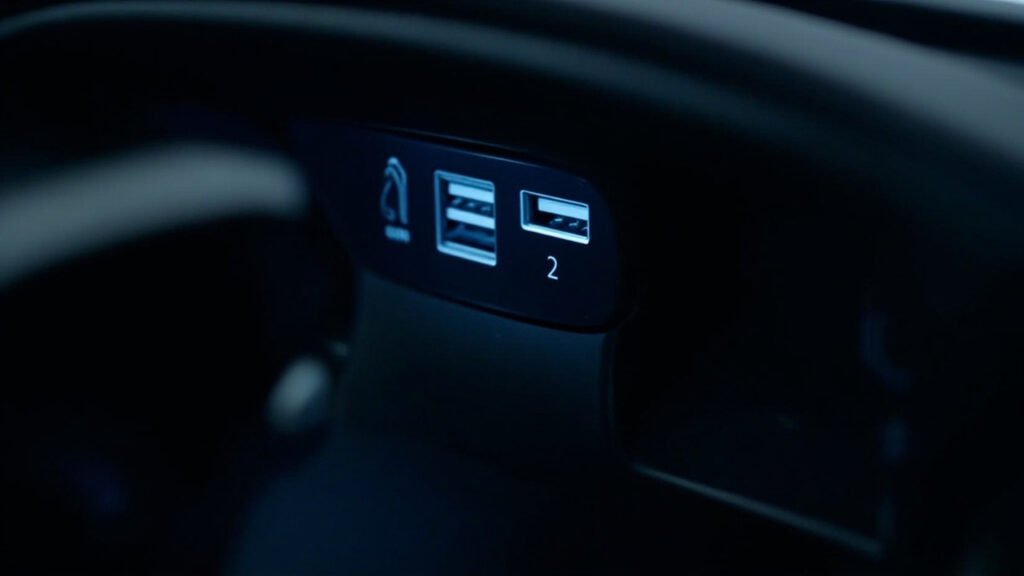
A stacked dual USB connector in an automotive application has to handle all of this while providing two independent ports — typically one for smartphone connectivity and one for a USB storage device, an OBD-II dongle, or a secondary accessory.
Why Automotive USB Is Different
| Requirement | Consumer USB | Automotive USB |
|---|---|---|
| Temperature range | 0–70°C | −40 to +85°C (engine compartment: −40 to +105°C) |
| Thermal cycling | None specified | −40/+85°C, 500–1,000 cycles |
| Vibration | None specified | Random 10–2000 Hz, 3–5 Grms |
| Shock | None specified | 30–50G, half-sine, 6ms |
| EMC | Basic FCC/CE | CISPR 25, conducted and radiated |
| Salt spray | None | 96+ hours ISO 9227 |
| Service life | 3–5 years | 10–15 years, 100,000–150,000 miles |
| Mating cycles | 1,500 minimum | 5,000–10,000+ (frequent use) |
| Connector retention force | 10N minimum | 25N minimum after 5,000 cycles |
The difference between consumer and automotive isn’t just about making the plastic housing thicker. It’s about material choices, contact design, assembly process control, and validation testing across the full environmental envelope.
Key Automotive Applications for Stacked USB
EV Charging Station Communication Module
An EV charger has a service/maintenance port that technicians access for diagnostics, firmware updates, and configuration. A stacked USB connector provides two ports — one for a diagnostic laptop (USB data) and one for a firmware update flash drive — in a single panel opening.
Requirements:
- IP67 sealed when mated, IP54 dust cover when unmated
- USB 2.0 is typical (diagnostic data rates, no SuperSpeed needed)
- Locking connector preferred (prevents accidental disconnection during service)
- Panel-mount with EMI grounding for the charger enclosure
In-Vehicle Infotainment (IVI) Head Unit
The center stack infotainment system in a modern car provides one or two USB ports for smartphone connectivity (Apple CarPlay, Android Auto), media playback, and software updates. A stacked connector puts both ports in a compact panel footprint — important because the center console area is heavily contested between the screen, HVAC controls, and physical buttons.
Requirements:
- USB 2.0 or USB 3.0 (Apple CarPlay uses USB 2.0; some Android Auto implementations benefit from USB 3.0 for faster response)
- Right-angle panel mount
- EMI grounding fingers for the head unit chassis
- Temperature: −40 to +85°C (cabin temperature extremes)
- Vibration rated per vehicle OEM profile
- 10,000+ mating cycle rating (daily phone connection for 10+ years)
Fleet Telematics Gateway
A telematics unit in a commercial truck or bus provides GPS tracking, engine diagnostics, and driver communication. A stacked USB port allows simultaneous connection of a diagnostic tool and a driver’s mobile device.
Requirements:
- USB 2.0
- IP65 minimum panel seal
- −40 to +85°C operating
- Heavy-duty locking mechanism (truck vibration environment)
- EMI shielding for the adjacent cellular and GPS antenna modules
OBD-II Dongle Interface
Many modern fleet management systems use a permanently installed OBD-II dongle that provides a pass-through USB port for service technicians. A stacked USB connector on the dongle gives the technician two ports to work with.
Requirements:
- USB 2.0
- Compact right-angle design
- 5,000+ mating cycles
- Automotive temperature range (OBD-II port is typically under the dashboard, exposed to cabin temperature extremes)
Automotive-Specific Connector Design Features
Wide-Temperature Materials
Standard PBT connector housings soften at 120°C and become brittle at −20°C. Automotive connectors need:
- **LCP (liquid crystal polymer):** Glass transition temperature >300°C, minimal thermal expansion, excellent chemical resistance. The default choice for automotive USB connectors.
- **PPS (polyphenylene sulfide):** Similar to LCP but slightly lower cost. Tg ~280°C. Good for interior applications where peak temperatures are lower.
- **PA46 (Stanyl):** High-temperature nylon. Tg ~290°C. Used when LCP is too expensive, but more moisture-absorbent than LCP.
The housing material also needs to survive the peak reflow soldering temperature in assembly — typically 260°C for lead-free solder. LCP and PPS handle this easily; PBT does not.
Contact Design for Vibration
In a vehicle, the USB connector experiences continuous low-amplitude vibration from the engine, road surface, and chassis flex. Over 100,000 miles, this vibration subjects the connector contacts to millions of micro-movements relative to the plug contacts.
This causes fretting corrosion — the micro-motion wears through the gold plating, exposes the base metal, and creates an oxidized high-resistance contact surface. The USB connection doesn’t fail outright; it becomes intermittent, with data errors that are nearly impossible to diagnose in the field.
Mitigation strategies:
- Higher contact normal force (0.5–1.0N per contact, vs 0.3N in consumer connectors)
- Thicker gold plating (≥30µ” over ≥50µ” nickel underplate)
- Beryllium copper C17200 base metal (higher fatigue strength than phosphor bronze)
- Contact geometry with a wiping action during insertion (self-cleaning)
EMI Management
A vehicle is an electrically noisy environment. The ignition system generates broadband EMI from DC to 1 GHz. The electric motor inverter in an EV generates high-amplitude conducted emissions on the DC bus that can couple into any unshielded connector.
A stacked USB connector for automotive use must include:
- Full 360° metal shell shielding around each port
- EMI grounding fingers that make consistent contact with the chassis
- Internal shielding between stacked ports (prevents one port’s noise from coupling into the other)
- The shield must terminate to chassis ground through a low-impedance path (multiple ground tabs or a wide ground strap, not a single narrow trace)
Comparing Panel-Mount vs PCB-Mount for Automotive
| Factor | Panel-Mount Stacked USB | PCB-Mount Stacked USB |
|---|---|---|
| Mechanical load path | Insertion force → panel → enclosure, not PCB | Insertion force → solder joints → PCB |
| EMI grounding | Direct chassis contact at panel | Needs ground fingers or spring contacts |
| Assembly | Connector panel mount + cable to PCB | Connector on PCB, aligned to panel |
| Serviceability | Replace connector without removing PCB | PCB must be removed to replace connector |
| Cost | Higher (two parts: connector + cable) | Lower (one part on PCB) |
For automotive, panel-mount with a flying lead to the PCB is often preferred because it isolates the connector’s mechanical load from the PCB. The panel takes the insertion/extraction force, and the flexible cable absorbs vibration between the connector and the PCB.
Regulatory & Validation Testing
Automotive USB connectors must pass vehicle OEM-specific validation testing, which typically references these standards:
| Test | Standard | Typical Requirement |
|---|---|---|
| High-temperature endurance | ISO 16750-4 | 1,000h at 85°C, verify electrical performance after |
| Low-temperature endurance | ISO 16750-4 | 1,000h at −40°C |
| Thermal shock | ISO 16750-4 | −40 to +85°C, 500–1,000 cycles, <30s transition |
| Random vibration | ISO 16750-3 | 10–2000 Hz, 3–5 Grms, 8h per axis |
| Mechanical shock | ISO 16750-3 | 30–50G, half-sine, 6ms |
| Salt spray | ISO 9227 | 96h continuous, no red rust, contact resistance <10mΩ change |
| Mixed flowing gas | IEC 60068-2-60 | 10-day exposure, verify contact resistance |
| Connector durability | USCAR-2 | 5,000–10,000 cycles, LLCR <10mΩ change |
| EMC | CISPR 25 | Conducted and radiated emissions, BCI immunity |
A connector that passes all of these is not a consumer-grade part with a wider temperature rating on the datasheet — it’s a fundamentally different design optimized for automotive reliability.
Summary
Automotive stacked USB connectors represent the high end of the reliability spectrum. The temperature range, vibration resistance, EMI performance, and material requirements are an order of magnitude more demanding than consumer electronics.
Key takeaways for automotive specifiers:
- LCP housing, not PBT
- Gold plating ≥30µ” over nickel, on beryllium copper or high-performance phosphor bronze
- Panel-mount preferred over PCB-mount for mechanical load isolation
- Full 360° metal shell shielding with chassis ground contact
- Demand validation data — not just the datasheet numbers, but the test reports that back them up
- Internal shielding between stacked ports (prevents port-to-port EMI coupling)
GSConn’s automotive-grade stacked USB connectors meet USCAR-2 durability requirements, operate from −40 to +105°C, and are available with locking mechanisms, panel-mount flanges, and IP-rated sealing for under-hood and cabin applications.