
FEATURED ARTICLE
Right-Angle vs Vertical DC Jack Mounting: Solder Joint Load Paths
A barrel plug is heavy and long. Where its insertion force goes depends on orientation, and the failure signatures differ.
Read More →
Technical articles tagged Reliability: selection guidance, design rules and field data for Reliability connectors.
A barrel plug is heavy and long. Where its insertion force goes depends on orientation, and the failure signatures differ.
Read More →
A barrel plug is heavy and long. Where its insertion force goes depends on orientation, and the failure signatures differ.
Read More →
What a current rating actually means, how to derate it for a sealed enclosure, and where the barrel jack stops scaling.
Read More →
Gold flash and heavy gold differ by two or three decades in cycle life. Why the datasheet never states thickness, and how to specify it.
Read More →
Insertion force has to go somewhere. Panel mount puts it in the enclosure, PCB mount puts it in the solder joints, mid-mount puts it in the board edge.
Read More →
Contact failure is usually a localised film, not a broken beam. Why a second contact point changes the failure probability and how to verify it.
Read More →
Why a SIM socket cannot serve a payment terminal, how landing contacts remove sliding wear, and what plating a 100,000-cycle design needs.
Read More →
Why a datasheet contact resistance figure without a test method is meaningless, and how to write a requirement that survives qualification.
Read More →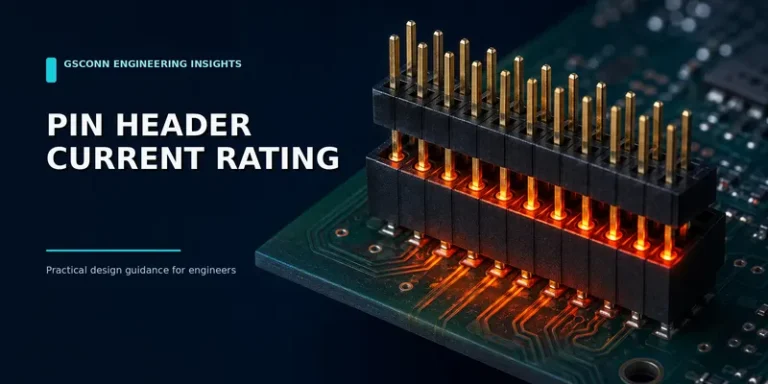
Pin Header Current Rating: Derating, Temperature Rise and Parallel Contacts Search results often assign one current value to an entire pitch—such as “3 A per pin for a 2.54 mm header.” That is not a safe design rule. Current rating belongs to a specific mated connector pair under defined test conditions. The female contact, contact […]
Read More →
Learn what a floating board-to-board connector does, when it is preferable to a rigid B2B connector, and how to select pitch, travel, mating height, current capability, and validation tests.
Read More →