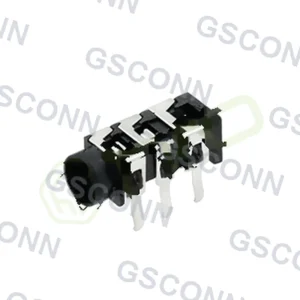
IP67 Audio Jacks: What the Rating Actually Covers

IP67 describes a test, not a guarantee
An IP67 audio jack has passed a specific test under specific conditions. Those conditions are rarely printed next to the rating, and the difference between “the jack passed the test” and “the product stays dry” is where most sealing failures originate.
This article unpacks what IP67 actually means for an audio jack, which surfaces are sealed, how the test is conducted, and the failure modes the rating does not cover.
What the two digits mean
| Digit | Level | Meaning | Test condition |
|---|---|---|---|
| First: 6 | Dust tight | No ingress of dust at all | Vacuum chamber with talc, no dust inside after the test |
| Second: 7 | Immersion | Ingress not harmful when immersed | Typically 1 m depth for 30 minutes, defined by the product standard |
IP67 is not “waterproof.” It is “survives a defined immersion without harmful ingress.” A jet of water at pressure is IPX5 or IPX6, a different test. Steam, condensation and chemical exposure are not covered at all.
Three sealing interfaces on a jack, not one
| Interface | What seals it | Rated by the jack? |
|---|---|---|
| Body to panel | O-ring or gasket around the mounting boss | Partly — depends on the panel and torque |
| Plug to jack bore | Sealing ring inside the barrel, or a sealed mating plug | Yes, if tested with a mating plug |
| Body to PCB or wire exit | Potting, gasket, or an encapsulated body | Yes, if the body is sealed |
A jack can be rated IP67 in one configuration and not in another. The rating is only meaningful alongside the mating condition, the mounting method and the panel preparation.
The mating condition question
This is the most commonly missed detail, and it decides whether the rating applies to your product.
| Test condition | Rating applies to | Real-world meaning |
|---|---|---|
| With a protective cap fitted | The capped jack | Protected only while capped; unprotected in use |
| With a mating plug inserted | The mated pair | Protected while a sealed plug is connected |
| Unmated, no cap | The jack alone | Protected when nothing is plugged in |
| Mated with an ordinary plug | Usually not rated | The most common real condition, and usually unsealed |
The last row is the gap. A jack rated IP67 with a sealing cap provides no protection once the user plugs in a standard, unsealed cable. If the product is expected to work while a cable is connected in wet conditions, the mating plug must be sealed too, and that is a cable assembly specification rather than a jack specification.
Ask the supplier which condition was tested. A rating quoted without a mating condition is incomplete.
How the test is run
| Step | What happens | What it does not cover |
|---|---|---|
| Dust test | Talc in a chamber with a pressure differential | Fine particulate under continuous airflow |
| Immersion | Defined depth and duration, then inspection | Repeated immersion, or immersion while hot |
| Post-test check | Visual inspection and function | Long-term corrosion from small ingress |
The “harmful ingress” wording is the loophole. A small amount of water inside a jack that still functions passes the test. That water then sits on the contacts and produces corrosion over months — outside the scope of the standard and inside your warranty period.
What IP67 does not cover
| Condition | Covered by IP67? | Relevant standard or mitigation |
|---|---|---|
| Condensation from thermal cycling | No | Breathing paths, desiccant, conformal coating |
| Pressurised water jets | No — that is IPX5/IPX6 | Different rating |
| Steam and vapour | No | Application-specific design |
| Salt spray corrosion | No | Salt spray testing, material selection |
| Chemical exposure | No | Material compatibility |
| Repeated immersion | Not by default | Cycle testing beyond the standard |
| Immersion while hot | No | Pressure differential drives ingress |
Condensation is the one that catches outdoor and washdown products. A sealed enclosure that breathes through a cable gland accumulates water over a season, and the jack is often the lowest point where it collects.
Designing the sealing as a system
| Element | Requirement | Common mistake |
|---|---|---|
| Panel hole | Correct diameter and flat sealing face | Hole too large, or a curved face that the O-ring cannot seal |
| Mounting torque | Specified and controlled | Over-torque flattens the gasket permanently |
| Mating plug | Sealed plug, or accept that the mated state is unsealed | Assuming the jack rating covers any plug |
| Drainage | Water that gets in can leave | A closed cavity with no drain path |
| Cable entry | Gland or sealed boot | Sealing the jack but not the cable |
| Contact plating | Gold with stated thickness | Thin flash that corrodes after minor ingress |
The drainage row is worth thinking through. A truly sealed assembly needs no drain. An assembly that will inevitably take on some water needs a path for it to leave without sitting on the contacts. The worst case is a nominally sealed assembly that traps a small amount of water against the contacts permanently.
Plating matters more when sealing is imperfect
No seal is perfect over a product’s life. Gaskets take a set, O-rings age, and users plug in unsealed cables. The plating is what determines whether a small amount of moisture becomes a failure.
| Plating | Behaviour with minor moisture ingress |
|---|---|
| Gold flash over nickel | Wears through quickly, then corrodes at the wear point |
| Gold with stated thickness | Corrosion barrier survives the wear depth over the product life |
| Tin or nickel only | Oxidises readily; not suitable for a wet environment |
If the sealing cannot be guaranteed for the product life, the plating specification becomes the reliability margin. Specify it accordingly.
Guide to the claims
| Claim | What to ask |
|---|---|
| “IP67 rated” | Tested with a cap, a plug, or unmated? |
| “Waterproof” | Which test, at what pressure and duration? |
| “Sealed” | Which of the three interfaces is sealed? |
| “Suitable for outdoor use” | Condensation tested? UV tested? Salt spray tested? |
| “IP67 with mating plug” | Is that plug available, and is it sealed? |
FAQ
Is IP67 the same as waterproof? No. It means dust tight and able to survive a defined short immersion without harmful ingress. Jets, steam and repeated immersion are different tests.
Does an IP67 jack make my product IP67? No. The panel interface, the cable entry and the enclosure all have to be sealed. The jack is one component of a system.
Is it rated with a plug inserted? Ask. Many ratings are achieved with a protective cap rather than a mating plug, which means the jack is unprotected in normal use.
Why did water get in if the jack is IP67? Either the panel gasket was not compressed properly, the hole face was not flat, or the water entered elsewhere and collected at the jack.
Does IP67 protect against condensation? No. Condensation forms inside sealed assemblies and is not covered by any IP rating.
What plating should I use for a wet environment? Gold with a stated thickness over nickel. Thin flash wears through and then becomes the failure point.
Audio Connectors for this design
View all 134 parts →