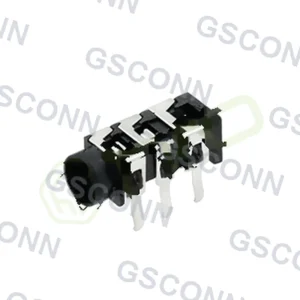
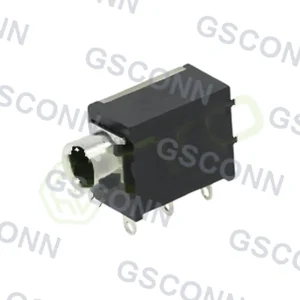
6.35mm vs 3.5mm Jacks for Professional Audio: When to Step Up

Why professional audio never adopted the small jack
The 3.5 mm jack is the consumer standard. The 6.35 mm jack — a quarter inch — is the professional and instrument standard, and it has held that position for over a century despite being larger, heavier and more expensive.
That persistence is not conservatism. A 6.35 mm jack solves specific problems that a 3.5 mm jack cannot: it survives being plugged in on stage, it carries a balanced signal on a heavy cable, and it holds a plug that weighs considerably more than a headphone lead.
This article compares the two on the parameters that matter for professional audio, and identifies the point at which stepping up is the correct engineering decision rather than a preference.
The physical difference
| Parameter | 3.5 mm (1/8 in) | 6.35 mm (1/4 in) | Ratio |
|---|---|---|---|
| Nominal diameter | 3.5 mm | 6.35 mm | 1.81 |
| Barrel circumference | ~11 mm | ~20 mm | 1.81 |
| Approximate contact area | Baseline | ~1.8× larger | 1.8 |
| Typical contact force | Lower | Higher | — |
| Panel area required | Small | Substantially larger | ~3× |
| Typical jack body depth | Shallow | Deeper | — |
The contact area ratio is close to the diameter ratio, which is what makes the difference in current capacity and durability roughly proportional to size rather than merely cosmetic.
What the larger contact area buys
| Property | Effect of larger area | Practical consequence |
|---|---|---|
| Contact resistance | Lower for the same pressure | Less signal loss over long cable runs |
| Current capacity | Higher | Can carry instrument-level and speaker-adjacent signals |
| Wear rate | Lower per cycle | Higher cycle life at the same plating thickness |
| Heat dissipation | Better | Less relevant for signal, relevant for speaker use |
| Tolerance to contamination | Better | A contaminated spot is a smaller fraction of the contact |
The contamination point is underrated. On a large contact patch, a film covering part of the surface still leaves a conductive path. On a small patch, the same film can cover most of it.
Balanced versus unbalanced: the reason TRS exists in 1/4 inch
A 6.35 mm jack in three-pole form is commonly used for balanced connections. The three conductors are hot, cold and shield, rather than left, right and ground.
| Configuration | Conductors | Signal type | Typical use |
|---|---|---|---|
| TS (2-pole) | Tip, sleeve | Unbalanced | Electric instruments, mono line |
| TRS (3-pole) | Tip, ring, sleeve | Balanced or stereo | Balanced line, stereo headphones |
| TRRS (4-pole) | Tip, ring 1, ring 2, sleeve | Stereo plus return, or headset | Specialised; less common in pro audio |
The same connector format serves two different purposes depending on how it is wired, and plugging a TS instrument cable into a TRS balanced input shorts the cold conductor to ground. Equipment has to tolerate that, and most does — but it is the reason balanced inputs are often specified with the ability to detect an unbalanced plug.
This ambiguity does not exist in the 3.5 mm world to the same degree, because 3.5 mm is almost always stereo unbalanced or headset. The professional ecosystem’s use of one connector for two signal types is a complication that comes with the format.
Mechanical durability: the stage argument
An audio jack on a stage or in a rack is subjected to conditions a consumer jack never sees.
| Condition | 3.5 mm | 6.35 mm |
|---|---|---|
| Plug and cable weight | Light leads only | Heavy instrument and patch cables |
| Side load from a hanging cable | High risk of damage | Tolerated |
| Stepped on, or a stand knocked over | Jack or plug likely destroyed | Often survives |
| Repeated connection during a session | Hundreds of cycles at most | Thousands |
| Service life expectation | A product lifetime | Decades in fixed installations |
The side-load row is the decisive one. A 3.5 mm plug inserted into a panel jack with a cable hanging from it acts as a lever, and the moment arm is the plug length. The jack’s contacts and the solder joints take that load continuously. A 6.35 mm jack, with its larger body and higher contact force, tolerates far more.
Where 3.5 mm is the right choice
| Application | Why 3.5 mm |
|---|---|
| Headphone output on any device | The headphone ecosystem is 3.5 mm |
| Line-level connection inside an enclosure | Short runs, no mechanical abuse |
| Portable and battery-powered equipment | Space and weight matter |
| Consumer and prosumer interfaces | The customer’s cables are 3.5 mm |
| Panel-space-constrained products | 3.5 mm needs roughly a third of the panel area |
There is no reliability argument for 6.35 mm in these cases. The connector is larger than the problem requires.
Where stepping up is correct
| Application | Why 6.35 mm |
|---|---|
| Electric instrument input | Every instrument cable in the world is 1/4 inch |
| Balanced line input or output | TRS balanced is the studio standard |
| Stage and touring equipment | Mechanical abuse and heavy cables |
| Patch panels and rack equipment | High connection density with repeated changes |
| Anything that will be stepped on | The large format survives |
| Long unbalanced runs | Lower contact resistance over distance |
The cost of stepping up
| Cost | Magnitude | Notes |
|---|---|---|
| Panel area | Roughly 3× the 3.5 mm footprint | The binding constraint in compact products |
| Jack body depth | Deeper | Affects enclosure depth |
| Unit cost | Higher | More metal, more contacts |
| Board area | Larger footprint and keep-out | Matters on dense boards |
| Insertion force | Higher | Requires adequate mechanical support |
Panel area is usually the deciding cost. A product with six jacks on the rear panel consumes a meaningful fraction of that panel with 6.35 mm parts.
Decision table
| Question | 3.5 mm | 6.35 mm |
|---|---|---|
| Will the customer bring their own cable? | Headphone or 3.5 mm ecosystem | Instrument or studio ecosystem |
| Is the cable heavy or long? | No | Yes |
| Will it be plugged in on stage or in a rack? | No | Yes |
| Is the signal balanced? | Rarely | Commonly |
| Is panel space tight? | Yes | No |
| Is the product portable? | Yes | No |
FAQ
Is 6.35 mm more reliable than 3.5 mm? In absolute terms yes — larger contact area, higher force, more tolerance to side load. Whether you need that depends on the mechanical environment.
Can I use a 3.5 mm to 6.35 mm adapter? Yes, but the adapter adds mass and lever arm at the small jack, which is exactly the load the small jack handles worst.
Why is 6.35 mm used for instruments? Because the instrument cable ecosystem is built around it, and because it survives stage conditions. Both reasons are about the installed base, not just the electrical performance.
Does a 6.35 mm TRS jack carry a balanced signal? It can — tip hot, ring cold, sleeve shield. The same connector is also used for stereo unbalanced, so the wiring depends on the equipment.
What happens if I plug a TS instrument cable into a TRS balanced input? The cold conductor is shorted to ground. Well-designed inputs tolerate this and drop to unbalanced operation.
Is panel space the main reason to stay with 3.5 mm? Usually, along with the connector ecosystem the customer already owns. If neither is a constraint, the larger jack is the more robust choice.
Audio Connectors for this design
View all 134 parts →