
Sealed vs Unsealed Connectors: When IP Ratings Matter
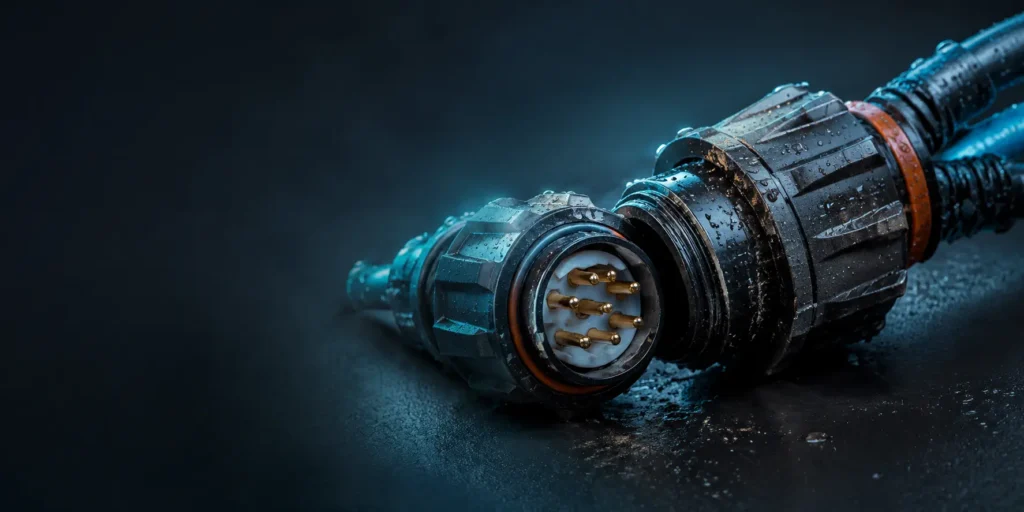
An IP rating is useful only when it matches the real installation. The connector may be sealed while the cable entry, panel cutout, unused cavities, cap, or enclosure still admits moisture. Decide at system level, then confirm the exact tested configuration and mounting instructions.
Quick Comparison
| Factor | Unsealed | Sealed (IP67+) |
|---|---|---|
| Dust protection | ❌ Dust enters | ✅ Dust-tight |
| Water resistance | ❌ None | ✅ IP67: 1m immersion |
| Moisture/humidity | Vulnerable | Sealed |
| Cost | Lower | 2–3× unsealed |
| Size | Compact | Larger (seals add bulk) |
| Mating effort | Easy | Moderate (seal friction) |
| Best for | Indoor, clean, dry | Outdoor, wet, dusty, washdown |
| Typical IP | IP20–IP40 | IP65–IP68 |
1. What “Sealed” Actually Means
A sealed connector has environmental barriers at every possible ingress point:
| Ingress Point | Seal Method |
|---|---|
| Mating interface | O-ring or gasket between housing halves |
| Wire entry (rear) | Rubber/silicone grommet or potted seal |
| Contact cavity | Individual wire seals (Deutsch-style) |
| Locking mechanism | Covered or sealed latch |
IP rating = ingress protection. The first digit describes protection against solids; the second describes protection against water under a defined test condition:
| IP | Solid | Water |
|---|---|---|
| IP54 | 5: dust-protected | 4: splash |
| IP65 | 6: dust-tight | 5: jets |
| IP66 | 6: dust-tight | 6: powerful jets |
| IP67 | 6: dust-tight | 7: 1m immersion 30 min |
| IP68 | 6: dust-tight | 8: continuous immersion |
2. When Sealed Is Overkill
Sealed connectors cost 2–3× and are larger. Skip sealing when:
| Scenario | Why Unsealed Is Fine |
|---|---|
| Indoor consumer (laptop, phone internal) | Climate-controlled, no water |
| Rack-mounted equipment | Server room, clean |
| Desktop peripherals | Dry environment |
| Internal board-to-board | Inside a sealed enclosure |
| Static industrial (dry) | Factory with controlled environment |
Key question: Is the connector inside an already-sealed enclosure? If yes, the connector itself may not need sealing — the enclosure provides the protection.
3. When Sealed Is Mandatory
| Scenario | Required Rating |
|---|---|
| Outdoor equipment (any) | IP65 minimum |
| Washdown (food, pharma) | IP69K (high-pressure hot water) |
| Marine / boat | IP68 |
| Submersible | IP68 (depth-rated) |
| Vehicle exterior | IP67+ |
| Dusty industrial (cement, grain) | IP65+ |
| Field equipment (agriculture, construction) | IP67 |
4. The Hidden Danger: Moisture Ingress Without IP Failure
Even “IP20” connectors can fail from condensation — moisture entering over time through vents and gaps. Condensation causes:
- Corrosion of contacts (gold worn → nickel oxides)
- Short circuits (moisture bridging pins)
- Reduced insulation resistance
- Intermittent connection
For humid environments (tropical, coastal, basements), sealed connectors prevent condensation-related failure even without direct water contact.
5. Sealing and Connector Selection
| Connector Type | Sealed Option | Typical Rating |
|---|---|---|
| M12 | ✅ Standard | IP67/IP68 |
| Circular (MIL) | ✅ Standard | IP67 |
| Deutsch DT | ✅ Standard | IP68 |
| Heavy-duty rectangular | ✅ | IP65–IP68 |
| USB | ✅ Panel-mount | IP67/IP68 |
| RJ45 | ⚠️ Rugged versions | IP67 |
| Wire-to-board | ⚠️ Potted or coated | Depends |
| Board-to-board | ❌ Not typically | Enclosure-sealed |
6. Selection Checklist
Map every ingress path, including the mating face, rear wire seals, unused cavities, cable gland, panel gasket, enclosure interface, and protective cap. Confirm whether the published rating applies mated, unmated, capped, or only after a specified assembly procedure. Also check temperature cycling, condensation, pressure changes, chemicals, salt spray, UV, and maintenance practices.
7. GSConn Sealed Connector Series
| Series | Rating | Type | Applications |
|---|---|---|---|
| CIR-M12 | IP67 | M12 | Factory automation, outdoor |
| DT-S | IP68 | Deutsch-style | Off-road, marine |
| EN-MAR | IP68 | 316 stainless | Offshore, saltwater |
| HDR-IP68 | IP68 | Heavy-duty rect | Washdown, outdoor |
| USB-PM-IP68 | IP68 | USB panel-mount | Kiosk, outdoor |
GSConn sealed connectors cover IP67 (M12, heavy-duty rectangular) and IP68 (Deutsch DT, marine, USB panel-mount). O-ring, grommet, and potted seal designs. Salt spray and immersion test reports available for marine and outdoor applications.
Related reading:
– Circular Connector Selection Guide
– M12 Connector Guide
– Deutsch DT Connector Guide