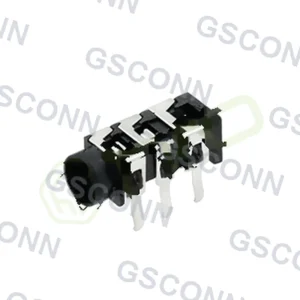
2.5mm vs 3.5mm Audio Jacks: Contact Area, Spring Force and Cycle Life

Half the contact area, and what follows from it
A 2.5 mm jack is not a scaled-down 3.5 mm jack. The geometry is similar, but the electrical and mechanical consequences of shrinking the diameter are not proportional — they are worse than proportional, because several properties depend on contact area while others depend on spring geometry.
This article compares the two sizes on the parameters that decide whether a design works: contact area, spring force, current capacity, retention and cycle life. It also identifies the applications where 2.5 mm is still the right choice despite the trade-offs.
The dimensional difference
| Parameter | 2.5 mm | 3.5 mm | Ratio |
|---|---|---|---|
| Nominal diameter | 2.5 mm (3/32 in) | 3.5 mm (1/8 in) | 0.71 |
| Barrel circumference | ~7.9 mm | ~11.0 mm | 0.71 |
| Contact patch width for a given finger | Narrower | Wider | — |
| Approximate contact area | ~50% of the 3.5 mm case | Baseline | 0.5 |
| Typical jack body height | Lower profile | Taller | — |
The contact area figure is the one that propagates. Contact resistance, current capacity and wear all scale with the area over which current passes and force is applied.
Contact force and what limits it
Spring force in an audio jack comes from a cantilever finger pressing on a curved barrel. In a smaller diameter, the finger is shorter, and a shorter beam is stiffer — but the available deflection is also smaller.
| Effect of smaller diameter | Direction | Net result |
|---|---|---|
| Shorter beam | Stiffer for the same deflection | Raises force per unit travel |
| Less available travel | Less deflection | Lowers force |
| Thinner material possible | Less force | Lowers force further |
| Smaller contact patch | Higher pressure for the same force | Partially compensates for contact resistance |
The net effect is that a 2.5 mm jack typically delivers lower absolute contact force on a smaller area. Higher pressure per unit area helps break through contamination, but there is less area to carry current and less margin when the finger relaxes with age.
Current capacity
Audio signal current is small, so this rarely matters — until it does.
| Load | Current | 2.5 mm suitability |
|---|---|---|
| 32 Ω headphone at 1 V RMS | ~31 mA | Fine |
| 16 Ω headphone at 1 V RMS | ~62 mA | Fine |
| 8 Ω speaker at 0.5 W | ~250 mA | Marginal — check contact rating |
| 8 Ω speaker at 1 W | ~350 mA | Not advisable |
| Power delivery over the jack | Application dependent | Not a power connector |
The same caution applies to both sizes: an audio jack is a signal connector, and using it to drive a speaker turns it into a power contact with much less margin on the smaller size.
Retention and plug walk-out
Retention scales with contact force and with the number of fingers pressing on the barrel. Both are lower on the smaller jack.
| Condition | 2.5 mm | 3.5 mm |
|---|---|---|
| Static retention | Lower | Higher |
| Tolerance to plug diameter variation | Poorer — the absolute tolerance band is the same but the diameter is smaller | Better |
| Behaviour under vibration | More prone to walk-out | More resistant |
| Effect of a worn jack | Loss of retention appears sooner | More margin |
The tolerance point is subtle and important. Plug diameter tolerances are specified in absolute millimetres, not as a percentage. A ±0.05 mm tolerance is 2% of a 2.5 mm plug and 1.4% of a 3.5 mm plug. The smaller connector therefore experiences a larger relative variation, which shows up as inconsistent fit between plugs.
Cycle life
| Parameter | 2.5 mm | 3.5 mm | Reason |
|---|---|---|---|
| Typical rated cycles | Lower | Higher | Smaller contact area wears through sooner |
| Plating wear rate | Faster per cycle | Slower | Higher pressure on a smaller patch |
| Spring relaxation | More significant | Less significant | Less travel means less reserve |
| Failure signature | Intermittent contact | Intermittent contact | Same mechanism, earlier onset |
Both sizes fail the same way — loss of contact force and plating wear. The smaller jack simply has less margin, so the same number of cycles consumes a larger fraction of its life.
Where 2.5 mm is still correct
| Application | Why 2.5 mm | Acceptable? |
|---|---|---|
| Ultra-compact body-worn devices | Physical space is the binding constraint | Yes |
| Aviation and intercom headsets | Established connector standard in the category | Yes — compatibility beats preference |
| Cordless phone handsets | Existing accessory ecosystem | Yes, if the ecosystem matters |
| Hearing-assist and specialized audio | Standard in the segment | Yes |
| General consumer audio | No benefit | No — use 3.5 mm |
| Industrial panel audio | No benefit, worse retention | No |
The pattern: 2.5 mm is justified when either the physical envelope demands it or the application’s ecosystem is built around it. It is not justified as a generic space-saving choice, because the reliability cost is paid continuously while the space saving is paid once.
Adapter complications
Using a 2.5 mm jack with a 3.5 mm adapter introduces a second connection in series.
| Issue | Effect |
|---|---|
| Additional contact pair | Extra resistance and an extra failure point |
| Mechanical lever arm | The adapter increases the moment on the small jack |
| Retention | The adapter may retain the plug better than the jack retains the adapter |
| Detection switches | The adapter does not reproduce the plug geometry the switches expect |
The detection row is a real trap. A jack designed to distinguish plug types by switch position will not behave correctly with an adapter inserted, because the adapter’s geometry is not the same as a plug’s. If the product depends on plug-type detection, adapters break it.
Decision summary
| Priority | Choose 2.5 mm | Choose 3.5 mm |
|---|---|---|
| Space | When nothing else fits | When space allows |
| Retention | Only if the plug is not disturbed | Any application with vibration or repeated use |
| Cycle life | Low-cycle products | Repeated connection |
| Ecosystem | When the segment standard is 2.5 mm | Default |
| Adaptation | Avoid if detection is needed | No adapter needed |
FAQ
Is a 2.5 mm jack less reliable than 3.5 mm? It has roughly half the contact area and less absolute contact force, so it reaches the same failure modes sooner. Whether that matters depends on cycles and environment.
Can I use a 2.5 mm to 3.5 mm adapter? Yes electrically, but it adds a contact pair, increases the lever arm on the small jack, and breaks plug-type detection.
Will a 3.5 mm plug fit a 2.5 mm jack? No. The plug is larger than the opening. Adapters are the only route, and they have the drawbacks above.
Does the smaller jack carry less current? Yes, because the contact area is smaller. Both sizes are signal connectors; neither should drive a speaker at high level.
Why does the same plug feel tighter in one 2.5 mm jack than another? Plug diameter tolerances are absolute, so they are a larger fraction of a smaller diameter. Fit varies more between combinations.
Should I use 2.5 mm to save space in an industrial panel? No. Panel applications need retention and cycle life, both of which the smaller jack gives up.
Audio Connectors for this design
View all 134 parts →