
Marine Waterproof USB Connector: Design Guide
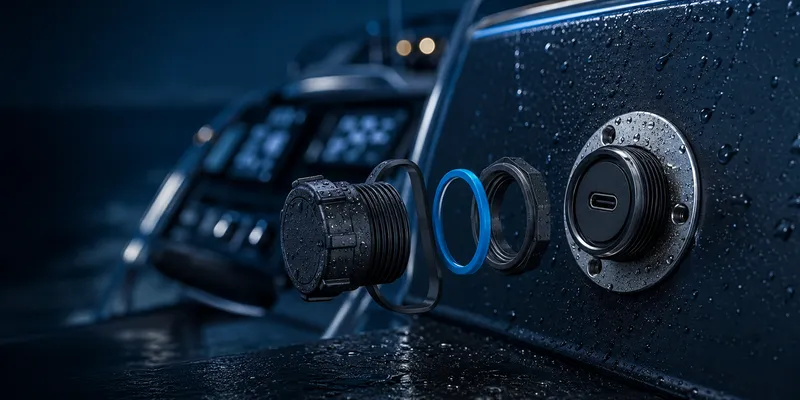
Marine Waterproof USB Connector: Saltwater, Vibration and UV Design Guide
Marine equipment exposes a USB port to salt spray, condensation, UV radiation, vibration and frequent handling. Selecting an IP-rated receptacle alone is not enough: the connector, cap, cable, panel, gasket and installation orientation must be treated as one sealing system.
Quick selection checklist
| Requirement | Questions to answer |
|---|---|
| Water ingress | Is the port exposed to spray, temporary immersion or continuous submersion? |
| Corrosion | Will salt mist, seawater, fuel vapour or galvanic couples be present? |
| Mechanical load | Will the cable be pulled, stepped on or vibrated by an engine? |
| UV exposure | Is the bezel or cap exposed on deck for long periods? |
| Maintenance | Must the port be cleaned, capped or serviced in the field? |
| Electrical function | USB 2.0, USB 3.x, charging only or USB-C PD? |
IP rating: specify the actual use case
IP67 and IP68 are not interchangeable marketing labels. IP67 generally addresses dust-tight protection and temporary immersion under the specified test conditions. IP68 requires the manufacturer and user to agree on the depth, duration and test conditions. A connector rated IP68 in one configuration may have a different rating with another cap, cable or panel thickness.
For an RFQ, specify:
- whether the rating is required when mated, unmated or both;
- immersion depth and duration, if IP68 is required;
- water temperature and pressure conditions;
- cable diameter and bend radius at the seal;
- panel thickness, mounting torque and gasket compression;
- the required test report or production inspection record.
Materials for saltwater service
Shell and hardware
316/316L stainless steel is often selected where chloride exposure is significant, but material grade alone does not eliminate corrosion. Pay attention to machining marks, passivation, fasteners, plating, crevices and contact with dissimilar metals.
| Material approach | Typical consideration |
|---|---|
| Nickel-plated brass | Suitable only when the environment and plating system have been validated |
| 304 stainless steel | May be adequate for lighter exposure; verify the actual salt-spray requirement |
| 316/316L stainless steel | Better chloride resistance; still requires suitable finishing and assembly practice |
| Engineering polymer housing | Low mass and good insulation; verify UV, impact and chemical aging |
Seal material
Choose the elastomer from the complete exposure profile, not from the water condition alone. Check compatibility with salt, cleaning chemicals, fuel, lubricants, temperature and UV. Silicone, EPDM and FKM/Viton may all be appropriate in different designs; the supplier should provide the compound and temperature range for the selected part.
Mechanical design features
Cap and unmated protection
A tethered cap prevents loss during service. Hinged caps are convenient on dashboards; threaded caps can provide a more controlled seal for exposed or engine-bay installations. The cap must be tested in the closed position, including tether loading and repeated opening.
Drainage and orientation
Mount exposed ports with the cable exit oriented downward where practical, add a drip loop, and avoid creating a pocket where water can collect. A sealed connector cannot compensate for water flowing along the cable into an unsealed rear termination.
Strain relief and retention
Use panel hardware, rear strain relief and cable support that match the expected pull and vibration. If the application is mobile, compare friction retention with a threaded, latching or locking USB design.
Electrical and EMC considerations
Waterproofing does not determine data speed. Confirm the required USB generation, impedance control, shielding, grounding and cable length. For USB-C, separately specify CC, VBUS current, USB Power Delivery, SuperSpeed pairs and any DisplayPort Alt Mode requirement.
High humidity can lower insulation resistance and increase leakage. Test the complete assembly after temperature-humidity cycling, salt exposure and mechanical vibration. Include ESD and conducted/radiated-emissions checks when the connector is mounted on an exposed metal panel.
Validation plan
- Inspect materials, plating, gasket geometry and assembly torque.
- Test ingress protection in the final panel, cap and cable configuration.
- Run salt-mist or cyclic-corrosion testing to the project specification.
- Apply vibration and mechanical shock while monitoring USB continuity and data errors.
- Cycle the cap and connector, then repeat the ingress and electrical tests.
- Inspect corrosion, seal compression set and contact resistance.
Do not publish a salt-spray duration, depth rating or temperature range unless it is tied to a specific part number, configuration and test method.
Marine USB RFQ checklist
Provide connector type, panel cutout, mounting direction, mated/unmated IP requirement, cable OD, shell and fastener material, seal compound, operating temperature, salt/cyclic-corrosion method, vibration profile, USB speed, current and mating cycles. Request drawings and reports for the exact assembly rather than relying on a family-level claim.
GSConn can review panel-mount Type-A, Type-C and dual-USB concepts for marine and outdoor equipment. The final IP, corrosion and temperature claims should be confirmed against the selected model and assembled installation.
FAQ
Is IP68 always better than IP67?
Not automatically. IP68 is meaningful only when the agreed depth and duration match the application. A well-installed IP67 port may be the better choice for spray-only service.
Does a stainless-steel shell make a connector marine grade?
No. Seals, rear termination, fasteners, plating, assembly and validation are equally important.
Can a waterproof USB port remain exposed without a cap?
Only if the exact unmated configuration has been tested and the product requirements allow it. Many ports need a cap to achieve their stated rating.
Related reading
Sources
Related reading on GSConn
GSConn application notes that complement this guide: