
Screw vs Spring Clamp vs Push-in Terminal Blocks
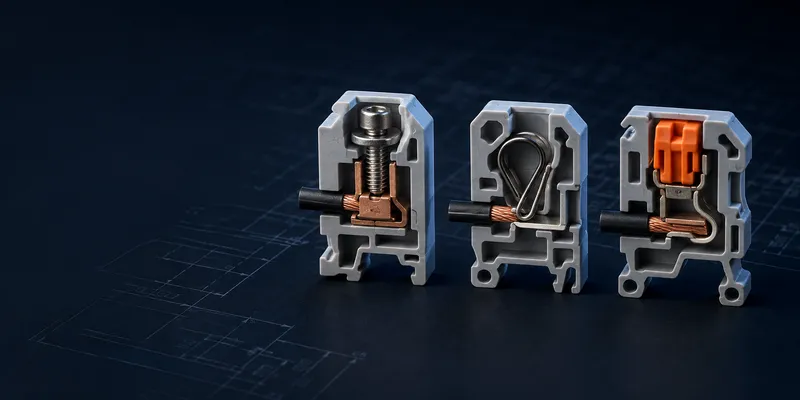
Screw, spring-clamp and push-in terminals can all create reliable industrial connections when they are matched to the conductor and installed correctly. The best choice depends on assembly volume, vibration, wire type, service practice, current range, operator access and lifecycle cost—not on one technology being universally superior.
Quick Comparison
| Feature | Screw Terminal | Spring Clamp (Cage Clamp) | Push-in |
|---|---|---|---|
| Wiring speed | Slow (screwdriver required) | Medium (tool to open, no tightening) | Fastest (solid wire: push only) |
| Vibration performance | Good when correctly selected and torqued; verify test data | Constant spring force; often selected for vibration | Constant spring force; verify conductor and test data |
| Maintenance | Follow manufacturer and equipment maintenance instructions | No torque step; inspect as the equipment plan requires | No torque step; inspect as the equipment plan requires |
| Wire range | 0.14–50mm² (all types) | 0.08–35mm² | 0.14–4mm² (solid), limited stranded |
| Stranded wire | Bare or ferruled when approved | Bare or ferruled when approved | Direct actuation or ferruled insertion, depending on design |
| Tool required | Screwdriver | Screwdriver (to open) | None (solid wire). Screwdriver to release |
| Gas-tight connection | ⚠️ Depends on torque (user-dependent) | ✅ Spring compensates wire creep | ✅ Spring compensates wire creep |
| Operator skill | Medium — must torque correctly | Low — tool opens, insert, release | Very low — push wire |
| Cost | $ | $$ | $$$ |
| Best for | General industrial, power distribution | Railway, machinery, vibration | High-volume production, panel building |
1. Screw Terminal: The Workhorse
The oldest and most widely used terminal. A screw drives a clamping cage that presses the wire against the current-carrying bar.
How It Works
Wire inserted → Screw tightened → Clamping cage presses wire against current bar → Connection madeTorque: The Critical Variable
| Wire Size | Recommended Torque | Under-Torque Risk | Over-Torque Risk |
|---|---|---|---|
| 0.5mm² | 0.4–0.5 N·m | Loose connection, overheating | Crushed wire strands |
| 1.5mm² | 0.5–0.6 N·m | High resistance | Deformed wire |
| 4mm² | 0.8–1.0 N·m | Wire may pull out | Stripped screw thread |
| 10mm² | 1.2–1.5 N·m | Partial contact | Thread damage |
Under-torque can increase contact resistance and heating; over-torque can damage the conductor, clamp or thread. Use the exact torque printed in the instructions and a controlled tool. Spring technologies remove the tightening-torque step but still require correct stripping and full insertion.
Vibration Loosening
Vibration performance is product-specific. A properly designed and installed screw connection can pass demanding tests, while a poorly torqued one can fail early. Compare the exact terminal’s vibration and shock qualification with the equipment profile.
2. Spring Clamp: Constant Contact Force
A spring element presses the conductor against the current bar with a defined contact force. The connection is opened by a screwdriver, lever or push button depending on the design.
How It Works
Screwdriver opens spring → Wire inserted → Screwdriver removed → Spring clamps wire → Connection madeAdvantages Over Screw
| Screw Terminal Failure | How Spring Clamp Avoids It |
|---|---|
| Torque varies by operator | No tightening torque step |
| Inconsistent torque | Spring force is constant (factory-set) |
| Wire creep (strands settle after tightening) | Spring follows the wire as it settles — maintains clamping force |
| Vibration | Defined spring force can provide stable performance; verify product qualification |
Disadvantages
| Disadvantage | Mitigation |
|---|---|
| Higher component cost in many series | Compare installed cost, wiring time and service cost |
| Requires screwdriver to open (not tool-free like push-in) | Standard flathead — any electrician has one |
| Lower max wire size (35mm²) | Screw terminals go to 50mm²+ |
| Conductor preparation varies by design | Follow the listed bare/ferruled conductor ranges and actuation method |
3. Push-in Terminal: Tool-Free Speed
Push-in terminals are spring clamps optimized for solid conductors: no tool needed to open the spring. The wire is simply pushed in.
How It Works
Solid wire pushed in → Spring yields → Wire seats → Spring clamps → Connection madeSpeed Comparison (100 terminations)
| Method | Time per Termination | Total Time |
|---|---|---|
| Screw terminal | 12–15 sec | 20–25 min |
| Spring clamp | 8–10 sec | 13–17 min |
| Push-in | 4–5 sec | 7–8 min |
Push-in wiring can substantially reduce assembly time, especially with rigid or ferruled conductors. The table is an illustrative production estimate; measure actual cycle time with your wire preparation, labeling and test process before calculating savings.
Limitations
- Direct push-in capability depends on conductor stiffness and terminal design. Flexible conductors may require the actuator or a correctly crimped ferrule.
- Do not assume a universal 4mm² maximum; high-current push-in families exist, while compact PCB versions may accept much less.
- Verify the approved conductor range for bare flexible, rigid and ferruled conductors separately.
4. Total Installed Cost Matters More Than Unit Price
Compare the entire connection process:
- terminal purchase price and accessories;
- wire stripping, ferrule crimping and insertion time;
- torque-tool calibration and quality checks;
- rework caused by incomplete insertion or incorrect torque;
- inspection, testing and field-service time;
- training and ergonomic impact across high termination counts.
A higher-priced terminal can be less expensive at the panel level when it reduces labor or rework. Conversely, a screw terminal may remain the best value for low-volume equipment and larger conductor ranges.
5. Which Connection Technology Should You Choose?
| Scenario | Recommendation |
|---|---|
| General purpose, cost-sensitive | Screw terminal |
| Vibration environment (railway, wind turbine, machinery) | Spring clamp |
| High-volume panel production (>500 terminations) | Push-in (solid wire) |
| Wire size >4mm² | Screw or spring clamp |
| Maintenance-free, long service life | Spring clamp or push-in |
| Field wiring with varied installer experience | Spring or push-in design with clear actuation and insertion indication |
| Legacy compatibility | Screw terminal |
Compare a Real Application
GSConn offers screw, spring-clamp and push-in families for PCB and DIN-rail mounting. Share the conductor types, termination count, current, vibration profile, target approvals and annual production volume to compare compatible series on both component and installed cost.
Related reading: