
High-Temperature Terminal Blocks: Ceramic and Polymer Guide
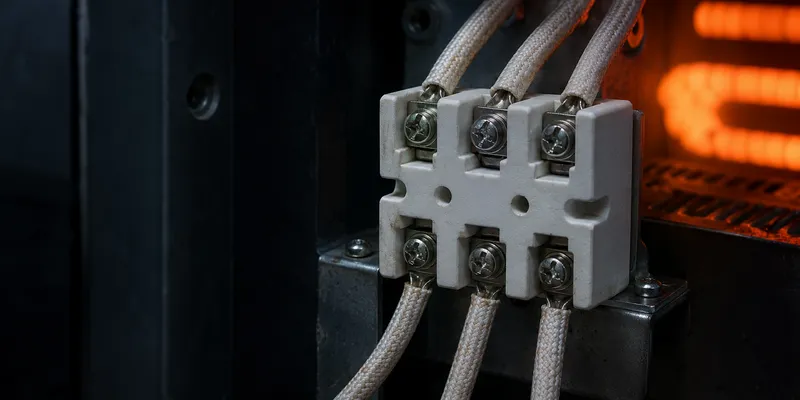
Selecting a terminal block for heat exposure requires more than checking the housing’s headline temperature. The usable limit is set by the complete connection system: insulation grade, metal alloy and plating, conductor insulation, mounting surface, creepage, tightening torque, atmosphere and time at temperature. This guide explains when a high-temperature polymer is sufficient and when ceramic becomes the safer choice.
Material Screening Guide
The temperatures below are broad material-family examples, not part ratings. Polymer performance varies significantly by grade, reinforcement, aging time and certification. Use the continuous-use data for the exact compound and complete terminal assembly.
| Material | Max Continuous | Peak | UL94 | Cost | Best For |
|---|---|---|---|---|---|
| PA66 (typical grades) | Up to about 105°C | Grade-specific | Grade-specific | $ | General industrial use |
| PBT (typical grades) | Often 105–125°C | Grade-specific | Grade-specific | $$ | Dimensional stability and electrical applications |
| Melamine | 150°C | 180°C | V-0 | $$$ | Heating appliances, industrial |
| Ceramic (steatite / alumina) | 250°C+ | 400°C+ | Non-flammable | $$$$ | Ovens, furnaces, heating elements |
| Phenolic | 150°C | 200°C | V-0 (with FR) | $$ | Legacy, electrical panels |
1. When Standard Terminals Are Not Enough
Many general-purpose polymer terminal blocks are suitable for control cabinets and PLC wiring, but nearby heaters, enclosed hot zones and process equipment can exceed their declared operating range. Verify the terminal’s own rating rather than applying a generic 105°C limit to all PA66 products.
| Application | Operating Temperature | Standard Terminal (PA66)? |
|---|---|---|
| Heating element connection (oven, furnace) | 200–300°C | Usually unsuitable; use a rated high-temperature system |
| Industrial dryer / kiln wiring | 150–250°C | Usually unsuitable |
| Automotive engine bay | 125–150°C | Grade and location dependent |
| Hot plate or heater connection | 180–250°C | Usually unsuitable |
| Steam-traced process equipment | 120–180°C | Grade, chemical and moisture dependent |
| Sauna / steam-room electrical | 100–120°C | Requires application-specific rating and moisture review |
2. Ceramic Terminal Blocks: The High-Heat Solution
Ceramic terminal blocks use steatite (talc ceramic) or alumina (aluminum oxide ceramic) as the insulating body. Metal hardware (brass or stainless steel screws, nickel-plated current bars) is mounted on the ceramic base.
Properties
| Property | Steatite Ceramic | Alumina Ceramic |
|---|---|---|
| Example assembly range | About 200–250°C | Potentially 300°C and above |
| Peak capability | Assembly-specific | Assembly-specific |
| Dielectric strength | 10 kV/mm | 15 kV/mm |
| Thermal conductivity | 2.5 W/m·K | 25 W/m·K |
| Water absorption | 0% (fully dense) | 0% |
| Flammability | Non-flammable | Non-flammable |
| Mechanical behavior | Brittle; protect from impact and mounting stress | Hard and brittle; design for controlled stress |
Design Considerations for Ceramic Terminals
| Consideration | Why |
|---|---|
| Brittleness | Ceramic cracks under impact. Mount securely, don’t overtighten screws. |
| Thermal expansion | Ceramic CTE is 6–8 ppm/°C vs brass 19 ppm/°C. The metal-to-ceramic bond must tolerate this mismatch over temperature cycles. |
| No deformation | Ceramic doesn’t soften at high temp — but it also doesn’t relieve stress. Overtightening a screw at 25°C can crack the ceramic at 300°C due to differential expansion. |
| Wire selection | Wire insulation must also withstand the temperature. Use silicone, PTFE (Teflon), or fiberglass-insulated wire. PVC insulation fails at 105°C. |
| Torque | Use the product-specific value. Ceramic can be damaged by excessive mounting or terminal-screw loads. |
3. High-Temperature Plastics: The Middle Ground
For applications between 125°C and 200°C, high-temperature polymers bridge the gap:
| Material | Max Continuous | Advantages | Disadvantages |
|---|---|---|---|
| PBT | Grade-specific, often 105–125°C | Good electrical properties and dimensional stability | Not automatically reflow- or high-heat suitable |
| Melamine | 150°C | Traditional, widely available | Brittle, limited suppliers |
| Phenolic | 150°C | Very old, proven | Contains formaldehyde, declining use |
| PPS (polyphenylene sulfide) | High-temperature grades available | Excellent chemical and thermal resistance | Higher cost and grade-specific processing |
| PEEK | Very high-temperature grades available | Strong thermal and chemical performance | Very high cost |
4. High-Temperature Design Checklist
- Define continuous temperature, peak temperature, dwell time and thermal cycling.
- Measure or model the temperature at the terminal—not just the oven or cabinet air temperature.
- Check conductor insulation, ferrule, screw, current bar and plating at the same temperature.
- Review oxidation, corrosive gases, humidity and contamination.
- Allow for differential thermal expansion and avoid imposing bending loads on ceramic bodies.
- Apply temperature derating to current capacity using part-specific data.
- Validate torque retention, temperature rise and insulation after thermal aging and cycling.
Common Questions
Is ceramic always better than a high-temperature polymer?
No. Ceramic offers high heat resistance and is nonflammable, but it is brittle, heavier and less tolerant of impact. A rated polymer can be preferable when its temperature and environmental limits provide adequate margin.
Can standard PVC wire be used with a ceramic terminal?
Only if the wire itself remains within its rated temperature. In genuinely hot zones, silicone, fluoropolymer or fiberglass-insulated conductors may be required. The complete wiring system must be rated.
Does a 400°C ceramic body make the terminal a 400°C product?
Not by itself. Metal oxidation, plating, screws, conductor insulation, mounting and certification may set a lower limit. Use the complete assembly rating.
5. GSConn High-Temperature Terminal Blocks
| Series | Material | Max Temp | Current | Wire Range | Features |
|---|---|---|---|---|---|
| TB-CER-4P | Ceramic (steatite) | 250°C | 30A | 0.5–4mm² | 4-position, brass screws |
| TB-CER-8P | Ceramic (steatite) | 250°C | 30A | 0.5–4mm² | 8-position, stainless screws |
| TB-HT-PBT | PBT | 125°C | 16A | 0.5–2.5mm² | PCB-mount, 5.08mm pitch |
| TB-CER-AL | Ceramic (alumina) | 400°C | 20A | 0.5–2.5mm² | For furnace/kiln, nickel-plated brass |
Hardware and plating options should be selected for the actual temperature and atmosphere. Confirm the exact material stack, torque and temperature rating in the series datasheet.
Review Your High-Heat Connection
GSConn offers ceramic and polymer terminal options for elevated-temperature applications. Provide the continuous and peak temperature, current, conductor, atmosphere, mounting method and approval requirements for a material and hardware recommendation with part-specific limits.
Related reading: