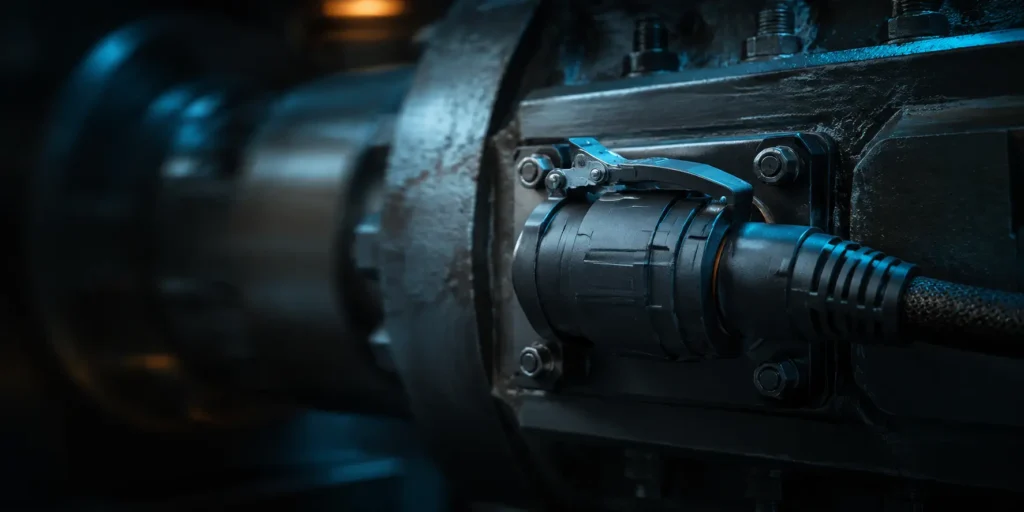
Vibration resistance and mating durability are different requirements. A connector can stay latched under vibration yet suffer fretting at the contacts, or survive thousands of mating cycles in a test fixture but loosen on machinery. The design must control housing motion, contact motion, cable loading, and PCB stress together.
Quick Reference
| Connector Type |
Vibration Rating |
Mating Cycles |
Locking |
| Deutsch DT |
Excellent (military-grade) |
100–500 |
Wedge lock + friction |
| M12 |
Excellent |
100–500 |
Threaded |
| MIL-DTL-38999 |
Excellent (aerospace) |
500+ |
Bayonet |
| Heavy-duty rectangular |
Excellent |
500+ |
Lever/bolt |
| Circular (threaded) |
Excellent |
500+ |
Threaded |
| Locking USB (screw) |
Good |
5,000–10,000 |
Screw flange |
| Standard USB |
Poor |
1,500–10,000 |
Friction only |
| Wire-to-board (latched) |
Good |
50–500 |
Latch |
| Board-to-board (mezzanine) |
Fair |
50–500 |
Friction |
1. How Vibration Kills Connectors
Vibration causes three failure modes:
| Failure Mode |
Mechanism |
Time to Fail |
| Fretting corrosion |
Micro-movement (5–10µm) at contact wears gold → nickel oxide |
1–6 months |
| Contact loosening |
Spring contacts lose tension from cyclic stress |
3–12 months |
| Housing separation |
Friction-fit connector vibrates apart |
Minutes to weeks |
| Solder joint fatigue |
Stress transfers through rigid connector to PCB joints |
6–24 months |
The Fretting Problem
Fretting is a common vibration-related failure mechanism. Micro-motion at the contact interface can:
1. Grinds gold plating away (5–10µm movement is enough)
2. Exposes nickel underplate
3. Nickel oxidizes (NiO is a semiconductor)
4. Contact resistance rises from <30mΩ to >100mΩ
5. Device becomes intermittent or fails
2. How Connectors Resist Vibration
| Defense |
Mechanism |
| Locking |
Prevents housing separation (screw, bayonet, latch, wedge) |
| High contact force |
Spring contacts with strong normal force resist fretting |
| Anti-fretting plating |
Gold over palladium-nickel resists wear better than gold over nickel |
| Rigid mating |
Tight fit minimizes micro-movement |
| Vibration damping |
Silicone or elastomer absorbs vibration energy |
| Mounting anchors |
Through-hole posts transfer stress to PCB, not joints |
3. High Mating Cycle Design
High-cycle connectors (test fixtures, medical, kiosks) need:
| Factor |
Standard |
High-Cycle |
| Gold plating |
0.5–1.0µ” |
3µ” or gold/palladium |
| Contact design |
Single spring |
Dual-beam or reinforced |
| Lubrication |
None |
Factory-applied contact lubricant |
| Housing wear |
500 cycles |
100K+ cycles |
| Typical rating |
100–500 |
10,000–1,000,000 |
Contact Plating Strategy
| Plating |
Cycles |
Use |
| Tin |
25–50 |
Solder-once |
| Gold flash (0.25µ”) |
100 |
Consumer |
| Gold 1µ” |
500 |
Industrial |
| Gold 3µ” |
5,000 |
High-cycle, test |
| Gold 3µ” + lubricant |
50,000+ |
Extreme (pogo pin) |
4. Mating Cycle Ratings by Application
| Application |
Required Cycles |
Connector Recommendation |
| Consumer device |
500–5,000 |
Standard USB, latched W2B |
| Industrial panel |
5,000–10,000 |
Locking USB, M12 |
| Vehicle (daily use) |
10,000+ |
Deutsch DT, threaded circular |
| Test fixture |
100K–1M |
Pogo pin, gold 3µ” + lubricant |
| Medical patient cable |
30,000–60,000 |
Medical push-pull, gold 3µ” |
5. Test Standards
| Standard |
Test |
| IEC 60068-2-6 |
Sinusoidal vibration (10–500 Hz) |
| IEC 60068-2-64 |
Random vibration |
| IEC 60512-6-4 |
Connector vibration |
| USCAR-2 |
Automotive connector durability |
| MIL-STD-202 |
Military vibration |
| LV214 |
German OEM connector spec |
6. Validation Checklist
Define the vibration spectrum, shock level, mounting direction, cable mass, strain relief, temperature range, current during test, allowable resistance change, mating-cycle target, and inspection criteria. Test the production-intent connector, contacts, crimp, wire, backshell, mounting hardware, and cable routing as one assembly. A locking feature prevents separation; it does not replace contact-system and strain-relief validation.
7. GSConn Vibration-Resistant Series
| Series |
Vibration Defense |
Mating Cycles |
Applications |
| DT-S (Deutsch-compatible) |
Wedge lock |
500 |
Off-road, marine, engine |
| CIR-M12 |
Threaded |
500 |
Factory, outdoor |
| USB-LK (screw lock) |
Screw flange |
10,000 |
Industrial panel |
| W2B-LK (latch) |
Latch + TPA |
500 |
Machinery |
| POGO-HC |
Pogo pin, lubricated |
500K+ |
Test fixtures |
GSConn vibration-resistant connectors include wedge-lock (Deutsch DT), threaded (M12), screw-flange (USB), and latched wire-to-board series. High-cycle options with 3µ” gold and contact lubrication for test and medical applications. Vibration and durability test reports available.
Related reading:
– Deutsch DT Connector Guide
– M12 Connector Guide
– Medical Device Connector Guide
– Sealed vs Unsealed Connectors