
USB Connector Manufacturer: How to Choose a Supplier
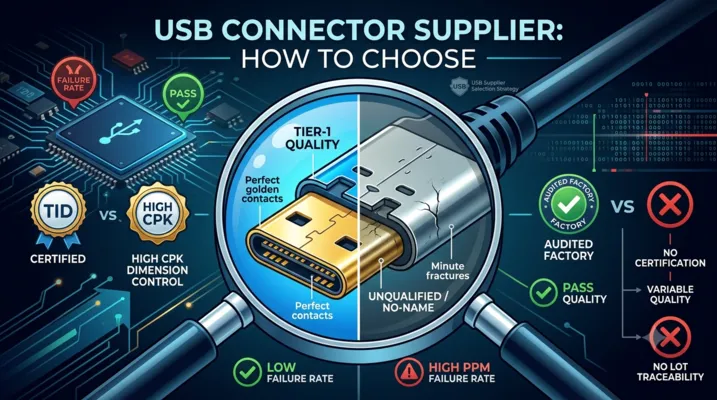
USB Connector Manufacturer: How to Choose a Supplier
The difference between a Tier-1 connector supplier and a no-name factory is not visible on the datasheet — it shows up in your production line 18 months later when 3% of units fail burn-in. Here is how to evaluate USB connector manufacturers before you commit.
Table of Contents
- The Supplier Landscape
- Tier Classification: Who Is Who
- The 10-Point Supplier Evaluation Framework
- Technical Capability Assessment
- Quality Systems and Certifications
- Factory Audit: What to Look For
- Pricing and Commercial Terms
- Supply Chain Risk Management
- Red Flags You Should Not Ignore
- The RFQ Process
- Building a Supplier Scorecard
- FAQ
The Supplier Landscape
The USB connector supply chain spans from $50B multinationals to family-run workshops. Understanding the landscape helps you match your needs to the right supplier tier.
Global Market Overview
USB connectors are a commodity — and also not. The basic USB 2.0 Type-A connector sells for $0.02 in volumes of 100k. A USB4-certified, IP68-rated, stainless steel USB-C connector with 30μ” gold contacts sells for $4.00. The same factory might make both, or neither. The challenge is knowing which supplier can reliably deliver the quality tier you need.
Geographic Distribution
| Region | Strengths | Weaknesses | Typical Tier |
|---|---|---|---|
| Japan (JAE, Hirose, JST) | Precision, reliability, miniaturization | Higher cost, conservative innovation | Tier 1 |
| USA/Europe (Molex, Amphenol, TE) | Broad portfolio, global support, certification | Higher cost, longer lead times for custom | Tier 1 |
| Taiwan (Foxconn, Lotes, ACON) | High-volume manufacturing, Apple/Intel supply chain | Limited catalog parts, focus on OEM | Tier 1–2 |
| China (Luxshare, Foxlink, Shenzhen cluster) | Lowest cost, fast turnaround, massive capacity | Variable quality, IP risk, language barriers | Tier 2–3 |
| Korea (KET, UJU) | Good quality, competitive pricing | Limited global distribution | Tier 2 |
Tier Classification: Who Is Who
Tier 1: Global Brands
Examples: Molex, Amphenol ICC, TE Connectivity, JAE, Hirose
Characteristics:
– USB-IF certified portfolio with published TIDs
– Full mechanical and electrical documentation (3D models, S-parameters, test reports)
– Global distribution (Digi-Key, Mouser, Farnell, Arrow)
– Application engineering support
– ISO 9001, IATF 16949, ISO 14001 certified
– PPAP Level 3 available for automotive
Pricing: $0.50–5.00 per connector at 10k volume
Lead time: 8–16 weeks (standard), 16–26 weeks (custom)
Minimum order: Often none for catalog parts (buy 1 from Digi-Key)
Best for: High-reliability applications, regulated industries, products with long lifecycles
Tier 2: Established Asian Manufacturers
Examples: Luxshare, ACON, Lotes, Foxlink, GCT
Characteristics:
– USB-IF certification on key products (not entire portfolio)
– Good documentation, sometimes with gaps
– Competitive pricing (30–50% below Tier 1)
– Direct sales, limited distribution
– ISO 9001 certified, some IATF 16949
– Willing to customize at moderate volumes
Pricing: $0.20–2.00 per connector at 10k volume
Lead time: 6–12 weeks (standard), 10–16 weeks (custom)
Minimum order: 1,000–5,000 pcs
Best for: Consumer electronics, cost-sensitive industrial, moderate-volume custom
Tier 3: Shenzhen Cluster
Characteristics:
– Thousands of small-to-medium connector factories
– USB-IF certification rare (claim “designed to” rather than certified)
– Minimal documentation — datasheet is often a single-page dimensioned drawing
– Lowest pricing, fastest turnaround
– Quality varies dramatically between factories
– ISO 9001 common, but audit quality varies
– Will customize at any volume (if you pay for tooling)
Pricing: $0.03–0.50 per connector at 10k volume
Lead time: 2–6 weeks (standard), 4–10 weeks (custom)
Minimum order: 1,000–10,000 pcs
Best for: Cost-sensitive consumer products, disposable devices, prototypes
Tier Classification: A Practical Test
Ask the supplier: “Can you provide S-parameter data for this connector to 10 GHz?”
- Tier 1: “Yes, here is the Touchstone file. We can also provide a 3D EM model for your simulation.”
- Tier 2: “We can provide insertion loss and return loss plots. Full S-parameters may require an NRE.”
- Tier 3: “What is an S-parameter?”
This single question filters suppliers more effectively than any certification list.
The 10-Point Supplier Evaluation Framework
| # | Criterion | Weight | What to Ask | Red Flag |
|---|---|---|---|---|
| 1 | USB-IF certification | Critical | “What is your TID for this part?” | Cannot provide a TID that verifies on usb.org |
| 2 | Quality system | Critical | “Show me your ISO 9001 certificate and last audit report” | Certificate expired or from an unrecognized registrar |
| 3 | Manufacturing capability | High | “What is your in-house process capability (Cpk) for critical dimensions?” | Cannot produce Cpk data |
| 4 | Technical support | High | “Can your FAE review our PCB footprint?” | No English-speaking technical contact |
| 5 | Delivery reliability | High | “What was your on-time delivery rate last quarter?” | Cannot provide the metric or rate below 90% |
| 6 | Financial stability | Medium | Request a credit report or bank reference | Reluctance to share, recent ownership change |
| 7 | IP protection | Medium | “How do you prevent our custom design from being sold to competitors?” | No clear answer, no NDA process |
| 8 | Secondary sourcing | Medium | “If your factory goes down, where is your backup production?” | Single factory, no disaster recovery plan |
| 9 | Environmental compliance | Medium | “Provide RoHS, REACH, and Conflict Minerals reports for this part” | Cannot provide current reports |
| 10 | Pricing stability | Low | “What is your annual price adjustment policy?” | No policy, “market price” only |
Technical Capability Assessment
What to Evaluate During a Technical Review
Design capability:
– Does the supplier have in-house connector design engineers, or do they only manufacture to customer drawings?
– What 3D CAD tools do they use? (SolidWorks, Creo, NX are standard)
– Can they perform mold flow analysis and signal integrity simulation?
– Ask to see a previous custom connector project from concept to production
Manufacturing capability:
– In-house tooling (mold making, stamping die fabrication) or outsourced?
– Plating: in-house or outsourced? (In-house is better for quality control)
– Assembly: manual, semi-automatic, or fully automatic?
– Inspection: manual visual, automated optical inspection (AOI), or both?
– What is the cleanroom classification of the assembly area? (Class 100,000 is typical; Class 10,000 for high-reliability)
Testing capability:
– In-house electrical test: contact resistance, insulation resistance, dielectric withstand?
– In-house mechanical test: insertion/extraction force, mating cycle durability?
– In-house environmental test: thermal shock, salt spray, mixed flowing gas?
– External lab partnerships for USB-IF compliance testing?
The Connector-Specific Technical Questions
| Question | Good Answer | Bad Answer |
|---|---|---|
| “What is the contact normal force?” | “0.8 N ±0.2 N per contact” | “Standard” or “enough to make good contact” |
| “What is the gold plating thickness on the contact area?” | “0.76 μm (30μ”) minimum on the wipe zone, 0.38 μm (15μ”) on the tail” | “Gold plated” |
| “What is the base material of the contacts?” | “C52100 phosphor bronze, half-hard temper” | “Copper alloy” |
| “What LCP grade do you use for the tongue?” | “Sumitomo E6008 or equivalent, UL 94 V-0, RTI 240°C” | “LCP” |
| “What is the co-planarity spec for the SMT leads?” | “0.10 mm maximum across all pins” | “Flat” |
Quality Systems and Certifications
Essential Certifications
| Certification | What It Means | How to Verify |
|---|---|---|
| ISO 9001:2015 | Quality management system in place | Request certificate, verify on registrar’s website |
| IATF 16949 | Automotive quality management (more rigorous than ISO 9001) | Check IATF database for current status |
| ISO 14001 | Environmental management system | Verify on registrar’s website |
| USB-IF TID | Connector passed USB-IF compliance testing | Search usb.org Integrators List |
| UL Recognition (E-number) | Connector evaluated for safety by UL | Search UL Online Certifications Directory |
| RoHS / REACH | Compliance with EU hazardous substance regulations | Request current test reports, not just certificates |
Beyond Certificates: Process Quality
Certificates prove a system exists. Process capability proves it works.
Request CPK data for critical dimensions:
– Contact pitch: Cpk ≥ 1.67 (5σ process)
– Contact co-planarity: Cpk ≥ 1.33 (4σ process)
– Shell dimensions: Cpk ≥ 1.33
– Insertion force: Cpk ≥ 1.33
If the supplier cannot produce CPK data, they are not measuring it — and if they are not measuring it, they are not controlling it.
Request a PPAP (Production Part Approval Process) for automotive or high-reliability applications. PPAP Level 3 includes:
– Design records
– Engineering change documentation
– DFMEA and PFMEA
– Process flow diagram
– Control plan
– Measurement system analysis (Gage R&R)
– Dimensional results
– Material and performance test results
– Initial process capability studies
– Appearance approval report (AAR)
– Part submission warrant (PSW)
Factory Audit: What to Look For
If you are committing to a supplier for 50,000+ units/year, visit the factory. If you cannot visit, hire a third-party audit firm (SGS, Bureau Veritas, TÜV).
Pre-Audit Checklist
- [ ] Request the factory layout and process flow diagram before visiting
- [ ] Prepare a checklist aligned with your evaluation framework
- [ ] Bring a camera (if permitted) and a notebook
- [ ] Plan 4–6 hours for the audit — do not let them rush you through in 90 minutes
What to Observe on the Factory Floor
| Area | What Good Looks Like | What Bad Looks Like |
|---|---|---|
| Incoming inspection | Calibrated CMM and optical comparator, sampling per AQL, records available | No inspection equipment visible, “we trust our suppliers” |
| Molding | Temperature and pressure monitors on each machine, mold maintenance logs | Oil leaks on floor, no process parameter records |
| Stamping | Die maintenance schedule posted, strip inspection at regular intervals | Dies stacked on floor, no lubrication system |
| Plating | XRF thickness tester in-line, bath chemistry logs | Plating outsourced to “a partner” (you lose visibility) |
| Assembly | ESD protection (wrist straps, conductive flooring), documented work instructions | No ESD protection, operators eating at workstations |
| Final inspection | AOI + functional electrical test on 100% of production | Visual inspection only, “sampling is good enough” |
| Warehouse | FIFO system, humidity control, labeled lots | Mixed lots, no traceability, boxes on floor |
The “Look in the Corner” Rule
The factory tour will show you the clean, organized areas. Before leaving, ask to see the rework area and the scrap cage. These reveal the factory’s real quality level — how many parts fail, and what they do with them. If the scrap cage is overflowing and the rework benches are busy, the first-pass yield is low.
Pricing and Commercial Terms
Understanding the Quote
A connector quote should break down:
| Component | Typical % of Price |
|---|---|
| Raw materials (plastic, metal, plating) | 30–45% |
| Labor (assembly, inspection, packaging) | 15–25% |
| Overhead (equipment depreciation, facility) | 15–20% |
| Tooling amortization | 5–10% |
| Profit margin | 10–20% |
If the quote is a single line with no breakdown, ask for one. If they refuse, they are hiding something — usually inflated tooling amortization or raw material assumptions.
Payment Terms
| Term | Tier 1 | Tier 2 | Tier 3 |
|---|---|---|---|
| Standard payment | Net 30–60 | Net 30 or T/T 30% deposit | T/T 50% deposit, balance before shipment |
| Letter of credit | Yes, at cost | Sometimes | Rarely |
| Consignment stock | Yes, for high volume | Negotiable | No |
| Price validity | 90–180 days | 30–90 days | 30 days |
Hidden Costs
- Packaging: Reel packaging for SMT placement costs more than bulk. Confirm packaging spec in the quote.
- Tooling maintenance: Molds and dies wear. Ask who pays for refurbishment and at what interval.
- Minimum order quantity: Ordering below MOQ may incur a surcharge of 20–50%.
- Shipping and duties: Incoterms matter. FOB Shenzhen vs DDP your factory door can differ by 15–25%.
- Quality escapes: Who pays for rework, scrap, and line-down costs if defective connectors reach your production line?
Supply Chain Risk Management
Single-Source Risk
A single-source USB connector is a single point of failure for your entire product. Mitigation strategies in order of effectiveness:
- Qualify a drop-in second source. Same footprint, same height, same electrical performance. This is the gold standard.
- Maintain safety stock. 3–6 months of inventory buffers against supply disruptions.
- Dual-source at the component level. If you cannot find a drop-in connector, at least ensure the contact material and plastic resin have multiple qualified suppliers.
- Tooling escrow. For custom connectors, keep a duplicate set of tooling at a neutral third party or second factory.
Geopolitical Risk
The USB connector supply chain is concentrated in China. Tariffs, export controls, and shipping disruptions can affect availability and cost.
| Risk | Mitigation |
|---|---|
| US Section 301 tariffs on Chinese connectors | Qualify a supplier in Taiwan, Vietnam, or Mexico |
| Shipping delays (2021 Suez, 2024 Red Sea) | Maintain 8–12 weeks of buffer stock, not 4 |
| Export controls on advanced materials | Verify that your connector does not use restricted substrates or plating processes |
| Factory shutdowns (COVID-style) | Diversify across at least two geographic regions |
Financial Risk
A supplier bankruptcy can halt your production overnight. Red flags:
– Delayed payments to their own suppliers (ask your sourcing contacts)
– Rapid ownership changes or private equity acquisition
– Declining on-time delivery rate over consecutive quarters
– Requests for accelerated payment terms (from Net 30 to T/T in advance)
Red Flags You Should Not Ignore
| Red Flag | Why It Matters | What to Do |
|---|---|---|
| Cannot provide a TID for a “USB-IF certified” part | The part is not certified | Reject the supplier or require certification before qualification |
| Refuses factory audit | Something is being hidden | Reject unless volume is very low and risk is acceptable |
| Datasheet has no tolerances | Dimensions are aspirational, not controlled | Request toleranced drawings; if refused, reject |
| “We can match any price” | They will cut corners to hit your target | Ask HOW they will match the price — material substitution? labor reduction? |
| No English-speaking technical contact | You cannot resolve design issues directly | Acceptable for Tier 3 only if you have a Chinese-speaking engineer on your team |
| Samples look perfect but lead time is “anytime” | Samples were hand-selected or made on a different line | Request samples pulled randomly from a production lot |
| Cannot provide a certificate of conformance (CoC) with each shipment | No lot traceability | Reject for any regulated or high-reliability application |
| Company is less than 3 years old | No track record of quality or delivery | Proceed with extreme caution; require bank guarantee |
The RFQ Process
What to Include in Your RFQ
A good RFQ saves weeks of back-and-forth. Include:
- Part number and description: Include the manufacturer part number if you have identified a candidate
- Quantity: Annual estimated usage (EAU), not just the first PO quantity
- Target price: Optional, but helps filter suppliers who cannot compete
- Technical requirements: Pin count, current rating, data rate, IP rating, temperature range, mating cycles
- Mechanical constraints: Mounting type, orientation, PCB thickness, enclosure dimensions
- Quality requirements: Certification needs (USB-IF, UL, IATF), PPAP level, CPK targets
- Commercial terms: Payment terms, Incoterms, packaging, lead time requirements
- Deliverables requested: Quote, datasheet, 3D model, samples, test reports, certificate copies
- Timeline: RFQ response deadline, sample delivery date, production start date
Evaluating Responses
Do not just compare prices. Create a weighted scorecard:
| Criterion | Weight | Supplier A | Supplier B | Supplier C |
|---|---|---|---|---|
| Technical compliance | 25% | |||
| Quality systems | 20% | |||
| Price | 20% | |||
| Delivery | 15% | |||
| Support | 10% | |||
| Financial stability | 5% | |||
| IP protection | 5% | |||
| Total | 100% |
Score each supplier 1–5 on each criterion, multiply by weight, sum. The highest score wins — even if it is not the lowest price.
Building a Supplier Scorecard
Once you have selected a supplier, track their performance quarterly:
| Metric | Target | Measurement Method |
|---|---|---|
| On-time delivery | ≥95% | (PO lines delivered on time) / (total PO lines) |
| Quality (PPM) | ≤500 PPM | (defective units) / (total units received) × 1,000,000 |
| Quality (lot acceptance) | ≥98% | (accepted lots) / (total lots received) |
| Cost competitiveness | Annual change ≤3% | Year-over-year price change |
| Responsiveness | ≤24 hours to technical queries | Average response time to email inquiries |
| Documentation accuracy | ≥99% | (correct CoC/lot traceability docs) / (total shipments) |
| Innovation | 1+ new product introduction/year | Count of new relevant products offered |
Review the scorecard quarterly with the supplier. If any metric falls below target for two consecutive quarters, initiate a corrective action plan. If the supplier fails to improve, begin qualifying an alternative.
FAQ
Q: Is it safe to buy USB connectors from Alibaba or AliExpress?
For prototyping and low-volume hobby projects, yes — but verify the parts upon receipt. For production, no. The counterfeit connector problem is real: connectors labeled as “Molex” or “Amphenol” on these platforms are often clones with inferior materials and no traceability. Buy production connectors from authorized distributors (Digi-Key, Mouser, Arrow, Farnell) or directly from the manufacturer.
Q: How do I verify that a USB connector is genuine and not counterfeit?
- Buy from an authorized distributor, not a broker
- Compare the physical part against the manufacturer’s datasheet under magnification — counterfeiters often get the logo font, mold markings, or plating color wrong
- Perform XRF analysis on the plating — counterfeit parts often have thinner gold or substitute palladium-nickel with nickel-only
- Check lot code traceability with the manufacturer
- If the price is 50% below the authorized distributor price, it is counterfeit
Q: Should I always choose the lowest-price supplier?
Only if price is your only criterion — and it should not be. A connector that costs $0.10 less but has a 2% field failure rate will cost you far more in warranty returns, brand damage, and rework than the $0.10 you saved. The total cost of ownership (TCO) for a connector includes: purchase price + incoming inspection cost + production rework cost + field failure cost. The lowest purchase price rarely has the lowest TCO.
Q: How many suppliers should I qualify for each USB connector?
Two is ideal: a primary supplier providing 70–80% of volume and a secondary providing 20–30%. This maintains competitive pressure on both while giving the secondary enough volume to stay engaged. Three is overkill for most applications and dilutes your purchasing leverage.
Q: What is the most common reason for supplier quality failures?
Plating. Specifically, insufficient gold thickness or poor nickel underplate quality. The gold looks shiny on arrival but wears through after a few hundred cycles, exposing the nickel (which oxidizes) or the base metal (which corrodes). This is impossible to detect by visual inspection — you need XRF measurement on every incoming lot, or at minimum on every new production batch.
This article is part of the USB Connector Technical Series. For related topics, see our guides on Custom USB Connector OEM/ODM, USB Type-C Complete Guide, and How to Choose the Right USB Type-C Connector.