
FEATURED ARTICLE
Right-Angle vs Vertical DC Jack Mounting: Solder Joint Load Paths
A barrel plug is heavy and long. Where its insertion force goes depends on orientation, and the failure signatures differ.
Read More →
Technical articles tagged PCB: selection guidance, design rules and field data for PCB connectors.
A barrel plug is heavy and long. Where its insertion force goes depends on orientation, and the failure signatures differ.
Read More →
A barrel plug is heavy and long. Where its insertion force goes depends on orientation, and the failure signatures differ.
Read More →
Insertion force has to go somewhere. Panel mount puts it in the enclosure, PCB mount puts it in the solder joints, mid-mount puts it in the board edge.
Read More →
What each switch position reports, how the sleeve switch distinguishes a three-pole plug from a four-pole one, and the firmware state machine that avoids pops.
Read More →
What survives a retrofit, what requires a re-spin, and the five layout decisions that keep the option open for later.
Read More →
The 0.09 mm thickness difference between 4FF and 3FF cards changes contact force, insertion feel and layout keep-out. What to specify before committing a footprint.
Read More →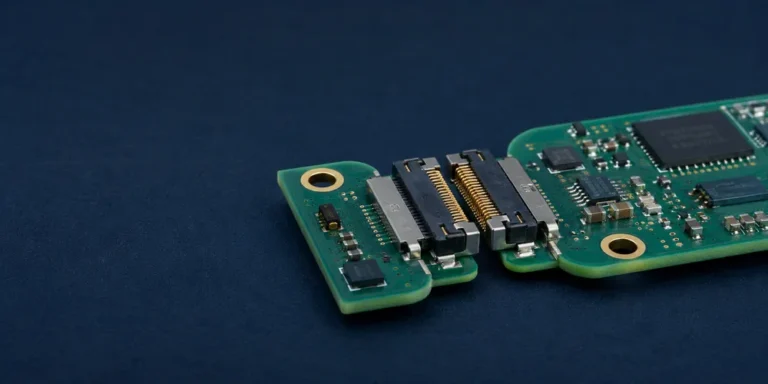
Design reliable coplanar board-to-board connections by comparing connector types, board-gap tolerance, floating interfaces, routing, and alignment.
Read More →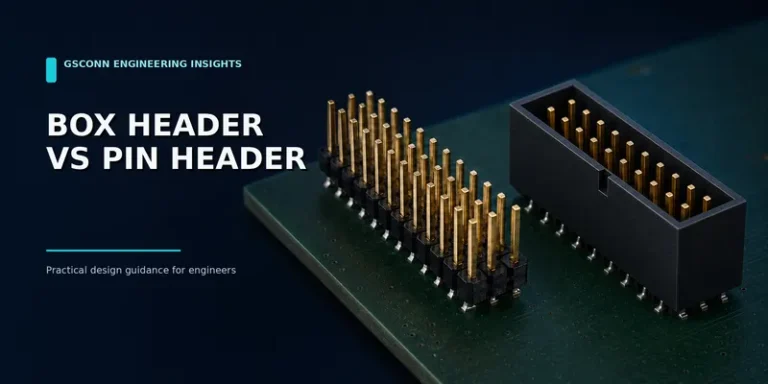
Box Header vs Pin Header: When a Shrouded Connector Is Worth It A box header is essentially a pin array surrounded by a molded shroud. That extra housing increases footprint and cost, but it can also protect contacts, guide mating, support polarization and provide a latch. The right choice depends less on the electrical schematic […]
Read More →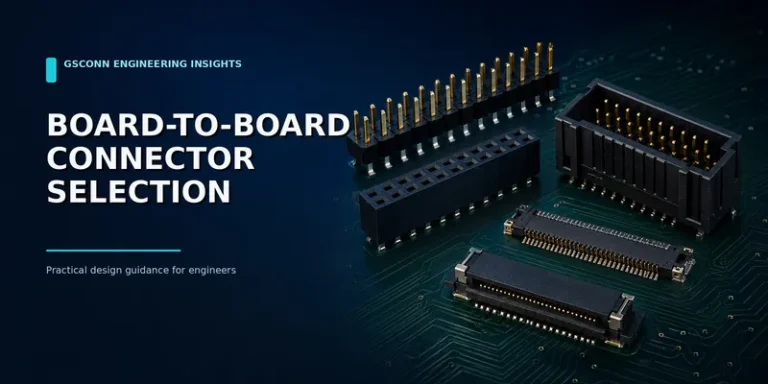
Board-to-Board Connector Selection Guide: A Practical Engineering Workflow Choosing a board-to-board (B2B) connector is not simply a matter of matching pitch and pin count. The connector also defines board spacing, assembly tolerance, serviceability, signal integrity, current density and, often, the mechanical architecture of the enclosure. This guide turns those requirements into a practical selection workflow. […]
Read More →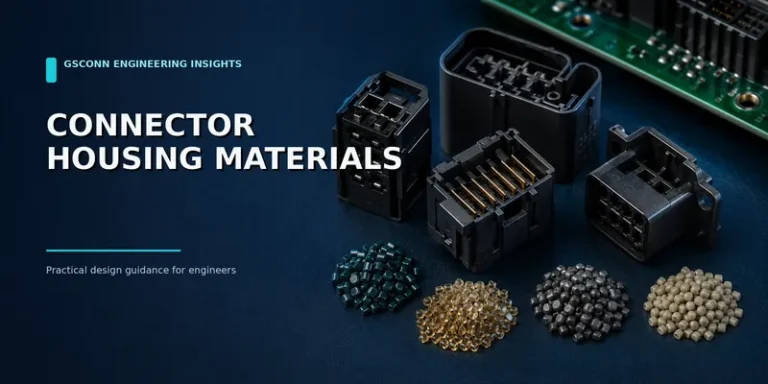
Connector Housing Materials: PBT vs LCP vs PA9T/PPA vs PPS The connector housing locates contacts, maintains creepage and clearance, survives soldering and protects the mating interface. Selecting the wrong resin grade can lead to reflow distortion, moisture-related dimensional change, latch fatigue or chemical damage. The most important correction to many material comparisons is this: polymer […]
Read More →